
Help us advocate for you. Please follow, share and like our content.
Why Manufacturing Plants Are Vital to Prince Edward County — More Than Ever
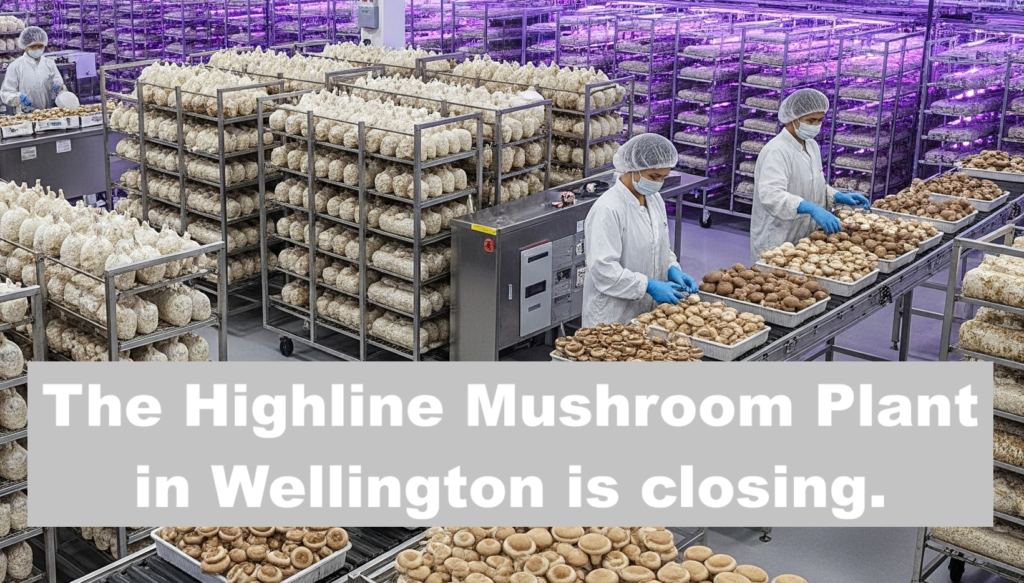
Highline announced internally that the Wellington plant is closing in December 2025. All 300 temporary and permanent employees are expected to be laid off. While many are foreign workers, at least 100 of the staff live in the area year round.
Prince Edward County can learn from Niagara. By combining tourism with processing and manufacturing, the County can step change manufacturing in the area. With growth projects underway, water and tax bills rising, and the cost of living stretching many families thin, we must reflect on what truly sustains a community. Among its most important pillars is manufacturing. When a plant like Highline Mushrooms shows signs of stress or possible downsizing, it underscores how fragile that pillar can be — and why PEC needs more, not fewer, manufacturing operations.
The County of Prince Edward has failed to present a job creation strategy to attract Manufacturers to the County. Nor have MPP Tyler Allsopp and MP Chris Malette offered tangible solutions to create well paying jobs with benefits here. Instead, we hear a push for low wage seasonal tourism and food retail jobs that cannot sustain families.
All this while, Ontario Premier Doug Ford said in October 2024, the province’s “tough” cost of living is one of the reasons why his government recently handed promotions to three Progressive Conservative MPPs, topping up their salaries by more than $16,000 a year. The promotions, the premier suggested, are to make up for the “unfair” base salary of $116,000 a year. So while MPP Tyler Allsopp earns $157,350 per year and MP Chris Malette earns $203,100 with robust and secure retirement benefits, paid by taxpayers, decent employment opportunities in the County are being gutted. Keep this in mind when you vote in future elections.
Median after-tax family income in 2023 in Prince Edward County was around $75,573, compared to a living wage estimate of $80,597 for a family of four. This gap shows why stable, better-paid jobs in manufacturing are essential.
What We Know About Highline Mushrooms & Local Manufacturing
Highline Mushrooms is one of Canada’s largest organic mushroom growers. Founded in 1961, it now has a reputation for sustainability and innovation.
- Company sources indicate Highline employs about 147 staff in Canada and has estimated revenues of $138 million annually. Its Ontario operations include sites in Leamington and Prince Edward County.
- In PEC, manufacturing contributes about $34 million in wages annually, compared with agriculture at $15 million and accommodations/food services at $20 million. This makes manufacturing one of the County’s most important year-round wage sectors.
This data shows manufacturing already plays a significant role in PEC’s economy: it out-earns agriculture and hospitality in wages and unlike these sectors, it provides more stable, year-round employment. Losing a plant threatens ripple effects in local spending, tax base, and employment stability.
The Problem: What Happens When Manufacturing Plants Lose Ground
When plants scale back, shut or shift production elsewhere:
- Jobs are lost: both direct (plant workforce) and indirect (drivers, suppliers, maintenance).
- Tax base shrinks: industrial property taxes often contribute disproportionately to municipal revenues.
- Local supply chains hollow out: businesses supplying packaging, logistics, and maintenance see less work.
Even the threat of closure or partial relocation (e.g. production moving to another plant) can dampen investment, reduce morale, and force workers to commute or leave the region.
Lessons from Niagara Region
Niagara provides a powerful case study of why manufacturing — especially in food processing — matters for rural and tourism-heavy economies.
- Fruit and vegetable canneries, once seen as outdated, have been revived and modernized to supply export markets. They provide hundreds of permanent and seasonal jobs, keeping agricultural products local for processing instead of shipping raw.
- The wine industry, which employs more than 18,000 people in Niagara, relies on processing, packaging, and distribution facilities in addition to tourism. Wineries and related food processors generate an estimated $4.4 billion in annual economic impact across Ontario, with Niagara at the core.
- By combining tourism with processing and manufacturing, Niagara has built an economy that buffers against off-season slowdowns. When tourist visits dip in winter, canneries, wineries, and food plants keep workers employed, sustaining incomes and municipal tax revenues.
This model highlights what PEC lacks: a strong processing/manufacturing base to balance tourism and agriculture. Without it, the County remains over-dependent on seasonal revenues.
More Local Data & Why It Matters
- In PEC, wages in manufacturing ($34 million) are more than double those in agriculture ($15 million).
- Median after-tax family income in 2023 was around $75,573, compared to a living wage estimate of $80,597 for a family of four. This gap shows why stable, better-paid jobs in manufacturing are essential.
- Manufacturing jobs also support long-term community stability: workers buy homes, keep children in local schools, and contribute to the local economy year-round.
What PEC Should Do: Action Steps
- Engage Highline Mushrooms and other plant owners
- Confirm any plans for closure or relocation, and negotiate retention of jobs, even if scaled down.
- Explore local business-friendly policies (e.g., utility cost relief, expedited permitting) to improve competitiveness.
- Attract new manufacturing, especially agri-processing
- PEC should target food processing, beverage production, and packaging operations that can add value to local agriculture.
- Offer serviced industrial land, ensure water/wastewater capacity, and promote PEC’s proximity to Toronto and Ottawa markets.
- Strengthen workforce training
- Partner with regional colleges for automation, food safety, and agri-tech training programs.
- Create pipelines from PEC high schools into skilled trades and food processing roles.
- Negotiate provincial and federal support
- Push for rural manufacturing investment funds similar to what Niagara has leveraged for food processing and winery expansion.
- Apply for agri-food processing grants and infrastructure partnerships.
- Transparency and accountability
- Publish annual manufacturing dashboards showing number of jobs, wages, and plant capacity in PEC.
- If production is being moved elsewhere (e.g., to Ingersoll), the public should see details and Council should push for community benefits.
The Case for Manufacturing Remains Strong
Manufacturing is not a cure-all. It requires infrastructure, a trained workforce, and strategic alignment. But the data are clear:
- Manufacturing already pays more wages than agriculture in PEC.
- Niagara’s success shows that food processing and manufacturing can buffer against off-season economic downturns.
- PEC cannot rely solely on tourism and agriculture; both are seasonal and volatile.
Without manufacturing plants, the County risks hollowing out its year-round economy. Retaining and expanding operations like Highline Mushrooms is essential for a stable tax base, sustainable employment, and long-term community health.