If you don’t read the whole thing… here’s the short of it:
Prince Edward County homeowners are once again facing steep property-tax increases — part of a long pattern of Council taking the lazy way out.
Instead of addressing inefficiency, wage inflation, or the cost of endless consulting, Council simply raises rates each year and congratulates itself for “balancing the budget.”
Taxes have nearly doubled in a decade, while population has barely moved.
A Decade of Tax Hikes
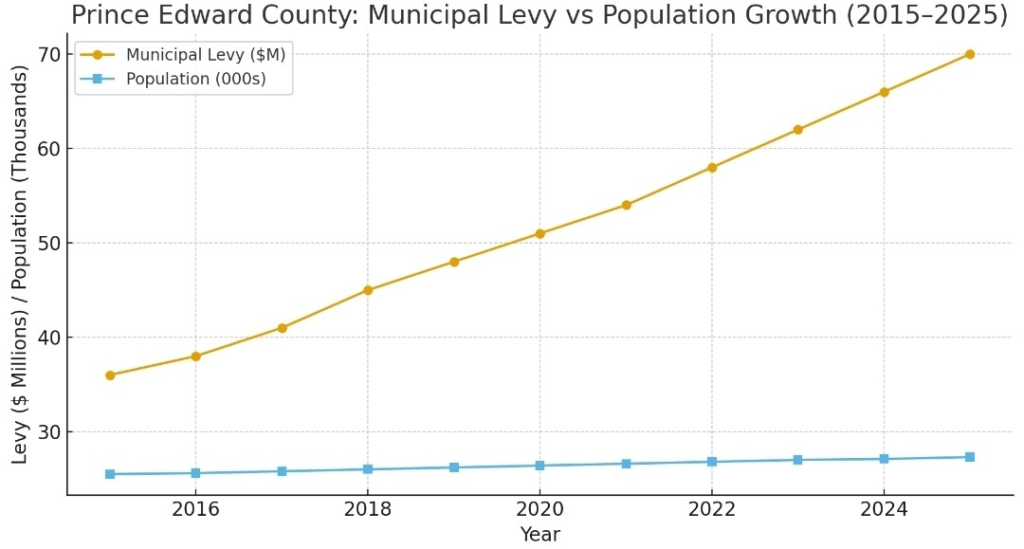
Since 2015, the County’s municipal levy — the total amount raised from property taxes — has climbed from $36 million to $70 million, a 94% increase.
Over that same period, population has grown by only 7%, and cumulative inflation has been roughly 30%.
| Year | Municipal Levy ($M) | Annual Growth | Population (000s) | Population Growth | Ontario Inflation (%) |
|---|---|---|---|---|---|
| 2015 | 36.0 | — | 25.5 | — | 1.1 |
| 2016 | 38.0 | 5.6% | 25.6 | 0.4% | 1.8 |
| 2017 | 41.0 | 7.9% | 25.8 | 0.8% | 1.7 |
| 2018 | 45.0 | 9.8% | 26.0 | 0.8% | 2.3 |
| 2019 | 48.0 | 6.7% | 26.2 | 0.8% | 2.0 |
| 2020 | 51.0 | 6.3% | 26.4 | 0.8% | 0.7 |
| 2021 | 54.0 | 5.9% | 26.6 | 0.8% | 3.4 |
| 2022 | 58.0 | 7.4% | 26.8 | 0.8% | 6.8 |
| 2023 | 62.0 | 6.9% | 27.0 | 0.7% | 4.0 |
| 2024 | 66.0 | 6.5% | 27.1 | 0.4% | 3.5 |
| 2025 | 70.0 | 6.1% | 27.3 | 0.7% | 2.5 |

Chart: Municipal levy growth has far outpaced both inflation and population, suggesting mismanagement rather than necessity.
Council’s Favourite Excuse: Inflation
Every year, staff and councillors repeat the same refrain: “Our costs are going up.”
That’s true — but it’s not the full story.
The County’s spending problem isn’t driven by inflation alone; it’s driven by unchecked payroll growth, redundant management layers, and dependency on consultants.
Staff wages and benefits have increased 80% in ten years, from about $19 million in 2015 to $35 million in 2024.
Contracted services — the outside consultants, studies, and “strategic reviews” — have nearly doubled, from $11 million to $20 million.
Residents see none of that in their daily lives. Roads remain cratered, water bills keep rising, and housing approvals take months.
A Culture of Easy Answers
Council’s budget process has become a ritual of avoidance.
Rather than interrogating costs, members accept whatever staff recommend, tweak a few numbers for optics, and declare victory.
The latest budget once again approved increases to management salaries, new hires, and external consulting contracts — without a single motion to cap or audit costs.
This is not governance; it’s autopilot.
How Prince Edward County Compares
| Municipality | Population | 2025 Tax Levy | 10-Year Change | Comment |
|---|---|---|---|---|
| Prince Edward County | 27,300 | $70M | +94% | Highest per capita burden in Eastern Ontario |
| Belleville | 56,000 | $142M | +45% | Twice the population, similar per-household tax load |
| Quinte West | 45,000 | $95M | +52% | Managed growth, broader assessment base |
Despite having half the population of Belleville, Prince Edward County collects nearly half the same total levy, meaning the average household pays far more than in neighbouring municipalities. And that doesn’t even include increasing debt.
Where’s the Oversight?
Council has not commissioned a full operational review in over a decade.
- There’s no performance-based pay, no departmental efficiency targets, and no public-facing “value for money” reports.
- Instead, residents are told each year that more tax hikes are “unavoidable.”
That’s not accountability — it’s inertia.
Real Fiscal Reform: Five Steps to Sanity
- Cap levy increases at inflation plus population growth (roughly 3–4%) — no exceptions.
- Commission a third-party efficiency audit of all departments and service contracts by mid-2026.
- Freeze consultant spending for one fiscal year and require departmental justification for renewals.
- Grow the non-residential tax base by fast-tracking light industrial and commercial zoning near Highway 62 and County Road 49.
- Tie management pay to measurable service outcomes: faster permits, road completion rates, and budget adherence.
The Cost of Inaction
An average household now pays over $5,000 annually in municipal property taxes — up from about $3,200 in 2015.
- For many seniors and working families, that’s not sustainable.
- As service costs and housing prices rise, the County risks becoming unlivable for the very people who built it.
The solution isn’t more tax — it’s better management.
Conclusion: Stop Reaching for the Easy Button
Raising taxes is the easiest political decision there is. It spares councillors from confrontation, shields staff from scrutiny, and avoids the hard work of reform. But leadership means doing what’s hard, not what’s easy.
It means saying no to unnecessary spending, asking tough questions, and defending the taxpayer, not the bureaucracy.
Until Council learns that lesson, every new budget will feel the same: higher taxes, lower trust, and no real change.
It’s time for Prince Edward County to stop taxing by habit and start governing by principle.