
Help us advocate for you. Please follow, share and like our content. Join our Facebook Group.
Prince Edward County’s housing crisis didn’t begin yesterday — but the County’s inability to manage it effectively might now be entering its most embarrassing chapter.
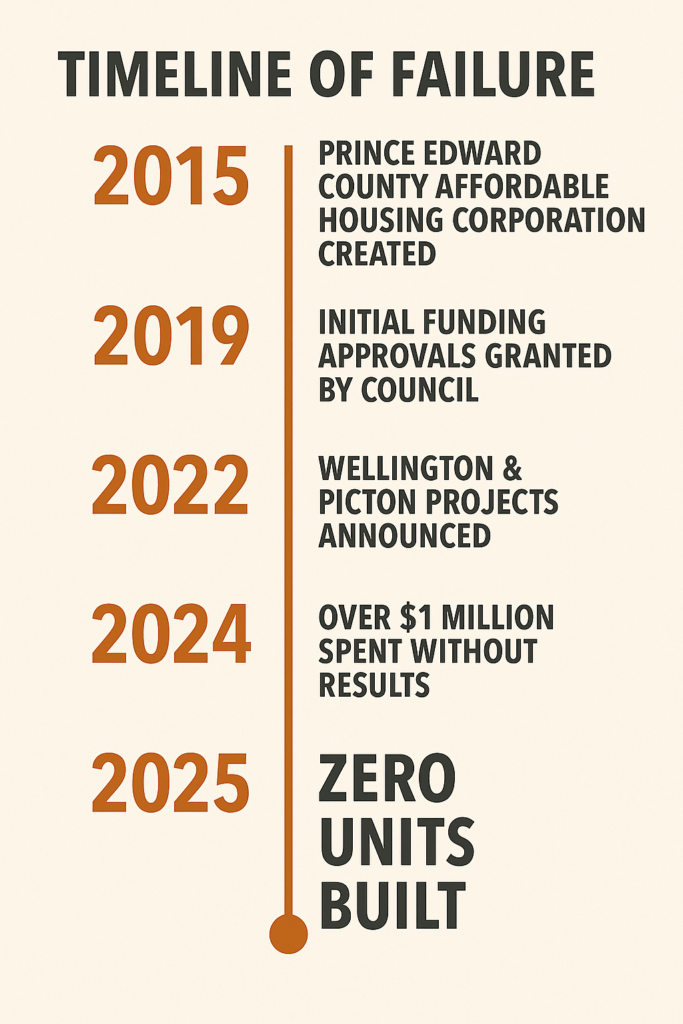
Ten years after it was formed with taxpayer funding, the Prince Edward County Affordable Housing Corporation (PECAHC) has yet to deliver a single completed home. Not one.
What was meant to be a focused, locally controlled engine for affordable housing delivery has instead become a monument to bureaucratic inertia, governance confusion, and administrative failure.
So an important question is what has the PEHAC Governance team accomplished in ten years? Why hasn’t a single affordable house been built in ten years after millions of dollars of tax money spent by PEHAC?

A Mandate Without Movement
When PECAHC was created, its mission seemed clear: build and facilitate affordable housing projects across the County using a mix of County-owned land, grants, and partnerships.
The corporation’s formation was sold to residents as a bold move — a way to get around red tape by giving a specialized, arm’s-length entity the flexibility to move faster than Shire Hall.
Instead, PECAHC has been buried in process, policy, and paperwork.
A decade later, the record speaks for itself: no occupied housing units, no completed developments, and no measurable return on public investment.
This article focuses specifically on the Prince Edward County Affordable Housing Corporation’s decade-long record of housing delivery, which is distinct from Leeward House, a County-led initiative delivered through a separate stream and property. We have reviewed multiple staff reports, audited statements, and council minutes showing no completed housing units directly delivered by PECAHC since its formation. That remains accurate as of 2025. An exception is Leeward House — it’s an important example of how adaptive reuse can work where new builds have stalled.
Millions Allocated, Nothing Delivered
County documents and financial statements show that PECAHC has received hundreds of thousands of dollars in operational funding, free access to County-owned land, and millions in authorized loans.
- The County approved up to $5 million in loans to PECAHC for two proposed projects: Wellington’s former Duke Dome site and Disraeli Street in Picton.
- PECAHC’s 2022 audited financial statements show revenues of $292,000, expenses of $122,000, and land transfers valued at approximately $180,000 recorded at zero.
- Pre-construction and consulting costs — surveys, site plans, servicing studies — are estimated to exceed $450,000 for Wellington alone.
- County Council continues to earmark funds and staff time for a corporation with no completed build.
Despite this spending, neither project is anywhere near occupancy. PECAHC’s own updates describe the developments as “pending financing and partner confirmation.”
The Cost of Confusion
At the heart of the problem is structure.
PECAHC is wholly owned by the County yet operates as a separate corporation. This halfway model — not fully municipal, not fully private — allows neither the efficiency of a true developer nor the accountability of a public agency.
Its board is composed largely of former councillors and community volunteers with no formal housing delivery expertise. Its executive functions are staffed by County employees who answer to both the corporation and Shire Hall.
That dual reporting line has led to a decade of blurred accountability — everyone responsible, and no one answerable.
An Expensive Lesson in Governance Failure
Residents might reasonably ask: how can a publicly funded housing corporation fail to build housing?
The answer lies in how PECAHC became a political shield — a convenient way for council after council to say “we’re working on it” while avoiding direct responsibility for results.
Every few years, the same cycle repeats:
- Announce a project.
- Hire a consultant.
- Submit a staff report.
- Discover cost overruns or servicing issues.
- Defer, study, and repeat.
Meanwhile, the housing crisis deepens. The average Picton rent for a two-bedroom unit now exceeds $2,000, while the County’s own social housing waitlist continues to grow.
What Should Have Been Done
If Prince Edward County had approached housing as an operational priority instead of a communications exercise, here’s what would have changed the outcome:
- Direct Delivery, Not Delegation. The County should have kept housing development in-house under a specialized municipal housing division — accountable to council, not an arm’s-length board.
- Land Bank and Build. A dedicated land bank should have been assembled in 2015–2016, securing parcels before speculation drove prices up.
- Partnerships With Real Builders. Instead of endless consulting rounds, the County could have contracted Habitat for Humanity, not-for-profit housing providers, or private builders through RFPs with strict delivery timelines.
- Rapid Modular Construction. Dozens of small municipalities across Ontario have used modular or prefabricated housing to deliver results in under two years — while PECAHC has spent ten years perfecting its mission statement.
- Transparency and Targets. Quarterly reporting on funds spent, units approved, and timelines missed would have created pressure for results. Instead, PECAHC reports have been sporadic, opaque, and often self-congratulatory.
The Price of Delay
By conservative estimate, PECAHC has now consumed well over $1 million in taxpayer value — when including staff time, land transfers, and consulting expenses — without producing a single occupied unit.
In the same decade, comparable municipalities such as Quinte West and Northumberland County have completed multiple affordable housing builds through partnerships with private developers and non-profits.
The result: Prince Edward County is further behind today than when it started.
A Province Watching — and Losing Patience
Under Ontario’s Municipal Act and the Housing Services Act, municipalities are legally responsible for ensuring adequate housing supply. Many have fulfilled that role by forming joint boards or leveraging provincial programs like the Ontario Priorities Housing Initiative (OPHI) and National Housing Strategy (NHS) funding.
Prince Edward County’s failure to deliver any measurable outcome may now put it at risk of losing credibility — and future funding eligibility — with both the province and CMHC.
Worse, the province’s new Housing Supply Action Plans (2023–2025) explicitly call for “demonstrated delivery capacity” when allocating funds. PECAHC’s record provides none.
What Happens Next
Calls are mounting for PECAHC’s dissolution and a full forensic audit of its finances and operations.
If council dissolves the corporation, all assets and responsibilities would revert to the municipality — where real accountability finally belongs.
That would allow the County to reset its housing strategy under direct council oversight, consolidate staff resources, and pursue partnerships with proven delivery agencies.
It’s not just a matter of optics — it’s a matter of trust. Residents deserve to know how so much time and money have been spent with nothing tangible to show.
The CountyFirst View
PECAHC is a symptom of a deeper problem at Shire Hall: an overreliance on committees, consultants, and process instead of outcomes.
Affordable housing was never going to appear through bureaucracy. It takes leadership, urgency, and execution — all of which have been missing for ten years.
The County doesn’t need another report. It needs keys in doors.
Leave a Reply