
Clearing Up Common Misconceptions
Food insecurity in Canada is often misunderstood. Some assume it affects only the unemployed. Others believe it is limited to major cities or remote northern communities. There is also a perception that food insecurity surged briefly during COVID-19 but has since stabilized.
The data tells a different story. Food insecurity now affects working households, families with children, rural communities, and urban centres alike. Rates have risen steadily in recent years, reaching levels not previously recorded in national surveys. Understanding the scope of the issue requires looking at the numbers.
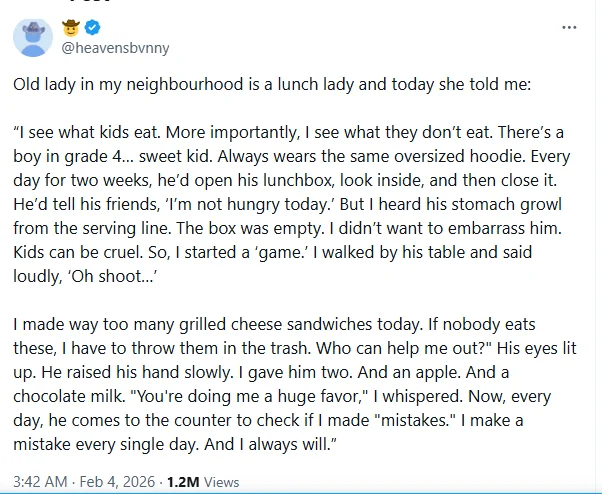
This happens more often than we would like to imagine.
A Steady Rise Since 2019
Household food insecurity refers to inadequate or insecure access to food due to financial constraints. It is categorized as marginal (worrying about running out of food), moderate (compromised quality or quantity), or severe (skipping meals or going entire days without food). According to Statistics Canada:
- 16.8% of people in the ten provinces lived in food-insecure households in 2019.
- 22.9% did so in 2023.
- 25.5% in 2024 — approximately 10 million people.
Severe food insecurity rose from 6.0% in 2023 to 6.7% in 2024. Moderate insecurity increased from 10.9% to 12.4%.
In the territories, overall food insecurity reached 37.4% in 2024, with Nunavut reporting rates above 50% in some surveys.1
These increases represent millions more Canadians experiencing financial strain around food access.
Children and Working Households
One of the most striking findings is the impact on children. In 2024, 32.9% of children under 18 — about 2.5 million — lived in food-insecure households. Food Banks Canada reports that 33% of food bank clients are children.
Employment does not eliminate risk. Approximately 19% of food bank clients report employment income as their primary income source. This indicates that wage growth has not kept pace with housing, energy, and grocery costs for many households.2
Grocery Bills Continue to Climb
Food prices have increased substantially in recent years.
Canada’s Food Price Report forecasts:
- 3–5% food price growth in 2025.
- 4–6% additional growth in 2026.
An average family of four is projected to spend approximately $17,571 annually on groceries in 2026 — nearly $1,000 more than the prior year.
Overall food prices are estimated to be roughly 27% higher than five years ago.3
Ontario: A Closer Look by Region and County
Food insecurity varies significantly across Ontario.
Provincial data shows approximately 25–28% of Ontario residents lived in food-insecure households in 2024.
However, public health unit and regional data reveals important variation.
Highest Reported Rates (Recent Surveys)
- Toronto Public Health: approximately 1 in 10 residents report severe food insecurity indicators.
- Thunder Bay District: rates exceed provincial averages, reflecting higher cost burdens and income variability.
- Windsor-Essex and parts of Northern Ontario: above-average rates in multiple surveys.
Eastern Ontario & Smaller Counties
In smaller counties across Eastern Ontario — including Hastings, Prince Edward County, Frontenac, and Leeds & Grenville — food insecurity trends generally mirror provincial growth patterns.
Key observations:
- Increased food bank usage year-over-year since 2021.
- Growing proportion of clients who are employed.
- Rising child participation rates.
- Demand outpacing donations in many local food banks.
Food bank usage in Ontario nearly doubled between 2019 and 2025, according to Food Banks Canada’s provincial breakdown.4
Smaller counties often face additional pressures:
- Limited grocery competition.
- Higher transportation costs.
- Lower average wages compared to major urban centres.
- Limited access to subsidized childcare and affordable housing.
In many counties, public health units have flagged food insecurity as one of the fastest-growing social determinants of health concerns.
Why This Matters
Food insecurity is not only about food access. It is closely tied to:
- Housing affordability
- Wage growth
- Inflation
- Energy costs
- Transportation
- Childcare expenses
When these pressures rise simultaneously, food budgets are often the first area households adjust.
Food insecurity is also linked to:
- Higher health care utilization
- Poorer educational outcomes for children
- Increased mental health stress
- Long-term chronic illness risk
The Road Ahead
Data projections suggest continued pressure if current economic conditions persist. Without meaningful changes in income growth relative to living costs, food insecurity rates could rise further in 2026 and beyond.
The numbers show that this is not a marginal issue. It affects millions of Canadians across income levels, geographies, and family types. Food insecurity is no longer confined to specific demographics. It has become a broad economic signal — one that reflects the overall cost of living.
Understanding the data is the first step toward addressing the problem.
Local Spending Priorities: Questions Around Resource Allocation
Against the backdrop of rising food insecurity — with more than 20% of residents provincially and local community estimates suggesting closer to one in four residents experiencing some level of food access strain — some residents have begun asking questions about municipal spending priorities in Prince Edward County.
These questions centre on how limited municipal resources are allocated when immediate social pressures coexist with long-term environmental goals.
In recent budget cycles, Prince Edward County has funded or pursued several climate-related initiatives consistent with its Strategic Plan 2023–2026, which identifies climate action and environmental resilience as municipal priorities. Documented initiatives include:
- Approval of a Municipal Climate Intern position, renewed for a second year in 2025.
- Applications for Federation of Canadian Municipalities (FCM) funding to support projects framed as climate adaptation, including improvements to Wellington beach infrastructure.
- Strategic planning commitments related to electric vehicle infrastructure, sustainability programs, and climate resilience planning.
- Maintenance of climate-related reserve funding, including corporate management climate emergency allocations referenced during 2025 budget deliberations.
During 2025 budget discussions, Council also debated adjustments to certain climate-related budget lines, including removal of $50,000 from a Corporate Management Climate Emergency allocation, which had approximately $423,000 in reserves at the time of discussion. Council minutes reflect both support and concern regarding these allocations.
These initiatives are framed by proponents as long-term risk mitigation efforts intended to address extreme weather events, shoreline protection, infrastructure resilience, and environmental stewardship. Supporters argue that failure to invest in climate preparedness could result in higher long-term costs — including infrastructure damage that could indirectly worsen food affordability and local economic strain.
At the same time, some community voices question whether the balance between future-oriented environmental initiatives and immediate social needs is appropriately calibrated, particularly given rising food bank usage and documented increases in food insecurity rates. They argue that when a significant share of households face difficulty accessing adequate food, municipal focus may need to lean more heavily toward direct relief measures, poverty mitigation partnerships, and local food system support.
Council has taken some steps in this direction. For example, budget deliberations included carrying forward approximately $20,000 in unspent food security funds to support partnership initiatives such as the PEC Food Collective. However, residents continue to debate whether additional reallocation from non-essential or longer-horizon projects could provide more immediate impact.
This discussion reflects a broader tension present in many municipalities across Ontario: how to balance environmental resilience planning with urgent cost-of-living pressures.
It is important to note that municipal governments operate within constrained fiscal authority. Social assistance, income supports, and large-scale food policy fall primarily under provincial and federal jurisdiction. However, municipalities influence land use, local grants, community partnerships, and discretionary program funding, making resource allocation decisions locally consequential.
Council minutes, the Strategic Plan 2023–2026, budget reports, Public Health Ontario data, and community organization updates provide the factual basis for this debate. The core issue is not whether climate initiatives have value, but whether current allocation levels appropriately reflect the scale of immediate economic hardship faced by residents.
As food insecurity rates rise, the question increasingly asked by residents is not ideological but practical: in a resource-limited environment, what should come first?
What Residents Can Do: Engage Your Representatives
Food insecurity is not a partisan issue. It is a cost-of-living issue. When one in four residents faces difficulty accessing adequate food, and food bank usage continues to rise, it is reasonable for citizens to ask how public dollars are prioritized at every level of government.
Residents who are concerned about spending priorities can take constructive steps:
Contact Your Municipal Councillor
- Ask how local budget allocations balance long-term initiatives with immediate cost-of-living pressures.
- Request clarity on reserve use, discretionary spending, and funding directed toward poverty mitigation or food security partnerships.
Contact Your MPP (Member of Provincial Parliament)
- Food security, income supports, public health funding, housing policy, and social assistance fall primarily under provincial jurisdiction.
- Ask how provincial funding formulas and cost-of-living measures are addressing rising food insecurity rates in your region.
Contact Your MP (Member of Parliament)
- Federal policy influences inflation, income supports, taxation, agricultural supply chains, and national food programs.
- Ask how federal measures are supporting affordability and whether additional targeted relief is under consideration.
When reaching out, residents may wish to ask:
- What measurable outcomes are tied to current spending priorities?
- How are rising food insecurity rates being factored into budget decisions?
- Are existing programs being evaluated for effectiveness?
- Are there opportunities to redirect discretionary spending toward immediate community needs?
Constructive civic engagement strengthens democratic accountability. Council meetings, public deputations, written submissions, and respectful correspondence are all legitimate and protected forms of participation under Canadian law.
Public budgeting always involves trade-offs. When residents participate thoughtfully, those trade-offs become clearer — and decisions become more transparent.
Sources:
- Statistics Canada, Canadian Income Survey (2019–2024).
- Food Banks Canada HungerCount 2025; Statistics Canada.
- Canada’s Food Price Report (Dalhousie University)
- Public Health Ontario; Food Banks Canada; regional public health unit reports.