Why Prince Edward County’s budget pressure is only just beginning
There is a number in the County’s own documents that changes everything.
It’s not the tax increase.
It’s not a single project.
It’s the gap.
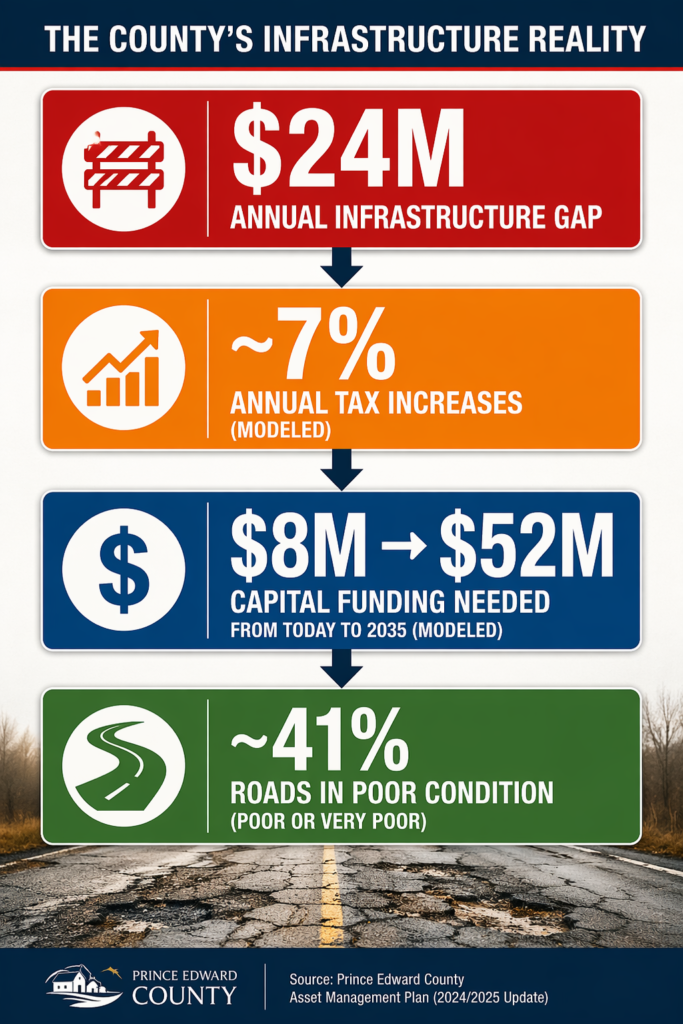
$24.2 million per year
That is the difference between what the County is currently spending on infrastructure and what its own plan says is required to maintain roads, bridges, and core assets.¹
What this really means
Most people see the 2026 tax increase and assume that’s the story.
It’s not.
The County’s own long-term plan shows:
- closing this gap could require ~7% tax increases annually for a decade²
- the total tax levy could double by 2035 under that scenario²
- capital funding needs could rise from ~$8M to ~$52M over that period²
That’s not a one-year issue.
That’s a structural shift.
Meanwhile, on the roads
Residents already feel the consequences.
According to the County’s own data:
- ~41% of roads are in poor or very poor condition³
That’s not a future problem.
That’s now.
So where is the disconnect?
The 2026 capital budget includes:
– ~$14M for roads
– ~$2.8M for bridges⁴
But also includes:
– waterfront improvements
– facility upgrades
– recreational investments
None of these are inherently wrong.
But they raise a simple question:
- Why are non-core projects moving forward while core infrastructure is still falling behind?
The bigger picture
This isn’t about one budget.
It’s about years of underinvestment catching up all at once.
And now:
- residents are being asked to absorb that catch-up
- through sustained, above-inflation tax increases
“This isn’t a bad year.
It’s a structural problem that will define the next decade.”
What happens next matters
Because this is where priorities become real.
If:
– the gap is ~$24M per year
– roads are already deteriorating
– taxes are expected to rise for years
Then the question isn’t whether to spend.
It’s:
what gets funded first—and what waits
Questions for Council
– What is the plan to reduce the $24M annual gap?
– What projects are essential vs deferrable?
– How long will above-inflation tax increases continue?
– What protections exist for affordability?
Final thought
Budgets send signals.
And the signal here is clear:
Prince Edward County is entering a decade of sustained financial pressure
The only real question is:
how that pressure is managed—and who pays for it
Sources
- Prince Edward County Asset Management Plan – annual infrastructure funding gap (~$24.2M)
- Same plan – modeled levy increases (~7.28%), levy growth and capital projections
- Same plan – road condition data (~41% poor/very poor)
- 2026 Tax-Supported Capital Budget – roads and bridges allocations
(All documents available via: https://www.thecounty.ca → Finance → Budget & Asset Management)