
Help us advocate for you. Please follow, share and like our content. Join our Facebook Group.
Prince Edward County’s Chamber of Commerce has long described itself as the “voice of business.” But after another difficult year of closures, layoffs, and missed opportunities, that voice sounds increasingly out of tune with the real economic needs of the County.
Seasonal Jobs, Year-Round Problems
The Chamber’s latest presentation to Shire Hall painted a grim picture: Highline Mushrooms’ relocation to Leamington, Starbucks’ closure in Picton, Scotiabank’s Wellington branch shutdown, and ongoing Loyalist College program cuts. Each represents the same problem — an economy built on a fragile seasonal base.
Tourism has its place. It fuels restaurants, accommodations, and wineries. But the County can’t build a stable future on six months of business and six months of hibernation. A truly sustainable local economy demands year-round employment — jobs that provide benefits, pensions, and predictable income.
The Chamber, with its occasional municipal funding and tax-supported mandate, has not delivered that.
It is important to clarify that the Prince Edward County Chamber of Commerce is not municipally funded in any ongoing or operational sense. The Chamber is a non-profit, member-driven organization, sustained primarily through membership dues, business sponsorships, and project-based partnerships. While the Chamber occasionally receives time-limited service agreements or project grants from the Municipality or other levels of government, these represent a small portion of its total budget and are tied to specific initiatives—such as business outreach campaigns or digital tools that benefit the wider community. The Chamber does not receive funds from the Municipal Accommodation Tax (MAT). Its mandate remains focused on supporting local businesses, fostering year-round economic resilience, and advocating for the County’s business community independent of MAT-related tourism programs like Visit The County.
Where Other Chambers Lead, Ours Lags
Across Ontario, chambers in comparable communities have redefined their role — shifting from hosting networking events to becoming active partners in economic development, workforce strategy, and business innovation.
- In Orillia, the Chamber of Commerce partnered with Lakehead University and the City to develop a small-industry innovation hub specializing in clean-tech fabrication. The initiative not only attracted new manufacturers but also created over 150 permanent jobs in a city once heavily dependent on seasonal tourism.
- In Brockville, the Chamber took the lead in attracting a regional logistics centre by brokering a public-private land-lease agreement and coordinating workforce training through St. Lawrence College. The project provided a blueprint for how chambers can leverage their networks to deliver tangible local economic benefits.
- In Collingwood, facing similar pressures to Prince Edward County, the Chamber recognized its over-reliance on tourism and launched the Four-Season Workforce Strategy in partnership with Simcoe County Economic Development. The program offered wage subsidies for winter-season hires, helping local businesses retain skilled staff and reducing off-season economic slumps.
- In Haliburton Highlands, the Chamber collaborated with Fleming College and local municipalities to create the Entrepreneurship & Remote Work Hub, providing co-working spaces, mentorship, and access to digital-skills training — a model now cited by Ontario Chamber of Commerce reports as a rural economic success story.
In Prince Edward County, however, the Chamber’s capacity to undertake similar initiatives remains limited by minimal funding and organizational support. Its current activities are largely sustained by member dues and small project grants, leaving little room for the kind of strategic, long-term economic initiatives that have transformed other communities.
Until the Chamber is empowered — through greater community investment, municipal partnership, and modernized leadership — the County risks falling further behind its peers in building a resilient, year-round economy.
The MAT Money Mystery
In 2019, the County introduced the Municipal Accommodation Tax (MAT) — a 4 per cent levy on short-term stays intended to fund tourism development. According to County budget data, MAT revenues now exceed $1.2 million per year.
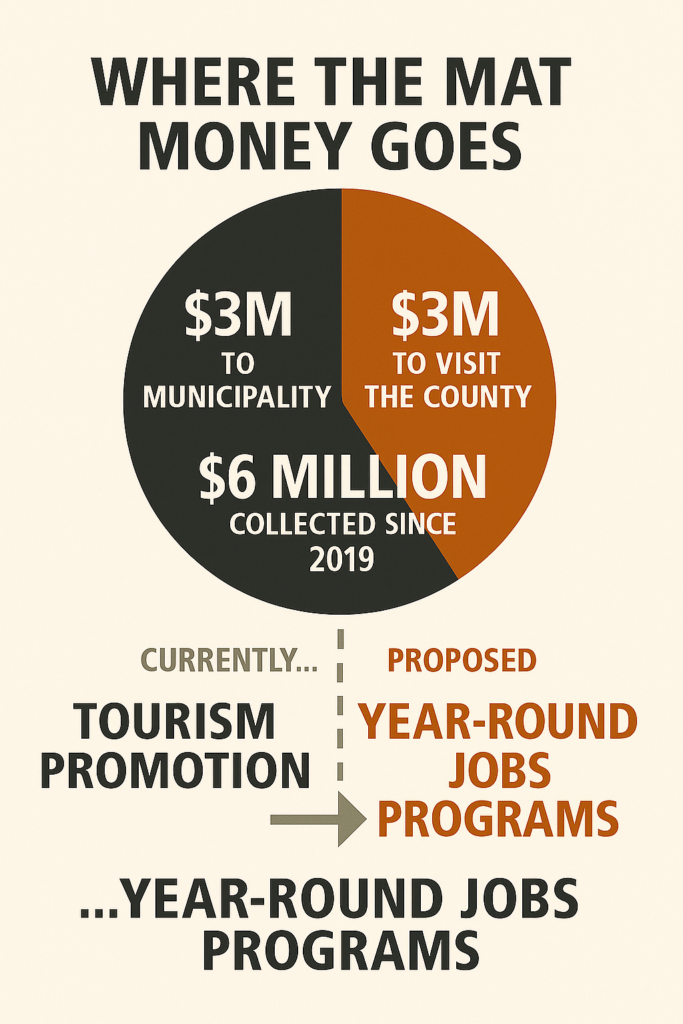
Half of that goes to the municipality; the rest is routed to Visit The County. Yet, after several years and millions collected, tangible results are difficult to find:
- No measurable increase in year-round employment.
- No permanent facilities or training programs established.
- Rising seasonal housing costs for workers, but no new workforce housing.
Businesses that rely on tourists may have benefited from short-term promotions, but the MAT has done almost nothing to diversify the economy.
- The MAT rate is 4%, effective February 1 2021. Prince Edward County Municipal Services
- In 2022, MAT revenue was reported as $1,372,303 with 50% of that going to the municipality (≈ $653,892) and the other half split between two tourism-related organizations. countylive.ca
- In 2023, the collected MAT amount was reported as $1,568,466. quintenews.com
- For 2024, the total MAT collected was cited as $1,296,155 with approximately $627,000 going to the municipality. quintenews.com
If even a fraction of those funds had been redirected to a Year-Round Employment Fund — providing seed capital for small manufacturers, IT firms, agri-tech ventures, and local service startups — the County might have dozens of sustainable jobs by now.
Tourism Can Stand on Its Own
Prince Edward County no longer needs to market itself. The problem isn’t a lack of awareness — it’s an overconcentration of resources on an industry that already dominates.
In 2024, Ontario attracted over 100 million overnight visitors. The County’s visitor numbers remain strong without additional public spending. Hotels, wineries, and event venues already budget for their own advertising. Yet tax-funded agencies continue to operate as if tourism were a fledgling sector.
That redundancy wastes money and deepens the region’s economic imbalance.
A Better Use for Public Funds
It’s time to re-engineer how economic development dollars are spent. CountyFirst proposes five steps:
- Dissolve or Merge Visit The County with the Chamber and refocus on economic diversification.
- Create a Year-Round Jobs Program funded by 50 per cent of MAT revenues to support small manufacturers, tech firms, health-care service startups, and trades training.
- Tie Municipal Grants to Performance Metrics — measurable outcomes like full-time jobs created, training sessions delivered, or investment attracted.
- Establish a Workforce Transition Fund helping seasonal workers retrain into sustainable sectors such as renewable energy, logistics, and care services.
- Publish Annual Return-on-Investment Reports so residents can see what every MAT and grant dollar actually delivers.
Accountability Starts with the Chamber
If the MAT is assigned to the Chamber in a Service Level Agreement with the municipality, it must be more than a line item. If taxpayers are funding this organization, it should be judged not by how many ribbon cuttings or luncheons it hosts, but by how many (audited) year-round jobs it helps create. County taxpayers deserve transparency, measurable outcomes, and the confidence that their money is building a stronger economy — not another round of glossy tourism campaigns.
The CountyFirst View
Prince Edward County has talent, land, and creative energy. What it lacks is focus.
It’s time to move from a visitor economy to a resident economy — one that keeps people employed, housed, and hopeful all year.
Tourism can take care of itself. The Chamber’s mandate should be to advocate for year round jobs. The MAT funding will empower the Chamber to do just that.
We welcome your feedback. If you spot an error, let us know and we will promptly correct it. Thank you.