
Why Eastern Ontario Is Losing Farmers Faster Than It’s Losing Farmland.
If you read recent headlines, you’d think Eastern Ontario is rapidly running out of farmland. Depending on the data source, we’re told that Prince Edward County “loses 3,000 acres a year,” or “hundreds of acres,” or “almost none at all.” Similar claims appear in Northumberland, Belleville’s hinterland, and rural Kingston.
The problem? The numbers contradict each other — and they risk distracting everyone from the real crisis.
Across Prince Edward County, Northumberland, Quinte, and Kingston’s rural townships, the most alarming trend is not the disappearance of acres. It’s the disappearance of farmers. While land shifts between “active,” “idle,” “rented,” or “conserved,” the farm population across Eastern Ontario is falling faster than anywhere else in the province.
The land isn’t vanishing. The people able to afford to farm it are.
THE NUMBERS: ACRES ARE SHRINKING… BUT FARMERS ARE SHRINKING FASTER
Across Canada, the total farmland area fell only about 3% between 2016 and 2021.
But the number of farmers fell at nearly 10 times that rate.
Since the 1960s, Canada has lost more than 60% of its farmers, with the farm population now below 2% of Canadians.
This pattern is mirrored across Eastern Ontario:
Prince Edward County
- 110,900 acres of farmland remain
- Only 375 farms
- Average farm: ~296 acres
- A significant decline from the multi-generational landscapes of 30–40 years ago
Northumberland County (including Brighton & Cobourg)
- Roughly 180,000 acres of farmland remain
- Over 850 farms in 1991… now around 650
- A drop of nearly 25% in just a generation
- The eastern portion of Northumberland is heavily grain-dependent, making it extremely sensitive to fertilizer, diesel, and interest-rate spikes
Belleville and Quinte Region
Belleville itself is largely urban, but surrounding areas (Thurlow Ward, Quinte West, Sidney, Frankford) have experienced:
- Farm consolidation
- Retirement sales
- Pressure from industrial and logistics development along the 401 corridor
The land remains; the farmers do not.
Kingston and Loyalist Township
- Strong pressure from suburban expansion
- Horse farms, hobby farms, and hay fields still dominate, but the number of full-time farmers has declined dramatically
- Many “farming” properties now generate more revenue from short-term rentals, weddings, or rural tourism than from agriculture
Brighton
- One of the most agriculturally productive areas east of PEC
- Still loses farmers annually due to aging demographics and rising operational costs
- High-value vegetable and apple production increasingly relies on fewer operators managing more land
Across the region, farmland is shifting hands.
What’s vanishing is the middle-class farmer who once formed the backbone of rural Ontario.
CITY FOLKS THINK IT’S ABOUT ACRES. FARMERS KNOW IT’S ABOUT ECONOMICS.
Many well-intentioned people believe farmland loss is simply about “development pressure.”
They’re not wrong — but it’s only one piece.
The economic pressures on farmers in Prince Edward County, Northumberland, and Kingston are often insurmountable:
1. Property taxes
Even with the reduced “farm tax class,” rising MPAC assessments hammer farmers.
A barn roof repair doesn’t raise your income… but MPAC will still raise your taxes.
2. Input costs
- Fertilizer costs surged 60–100% over the past decade
- Diesel remains volatile
- Machinery prices have nearly doubled
These increases have hit Eastern Ontario farmers harder because most are small to mid-scale — without the economies of scale seen in Western grain farming.
3. Electricity and energy
Ontario’s rising hydro rates disproportionately punish farm operations with fans, pumps, refrigeration, drying, and storage.
4. Interest rates
Many younger farmers rely on operating loans.
The 2022–2024 rate hikes pushed several farm operations in PEC and Northumberland into restructuring or land sales.
5. Tight margins
Perhaps the most misunderstood issue:
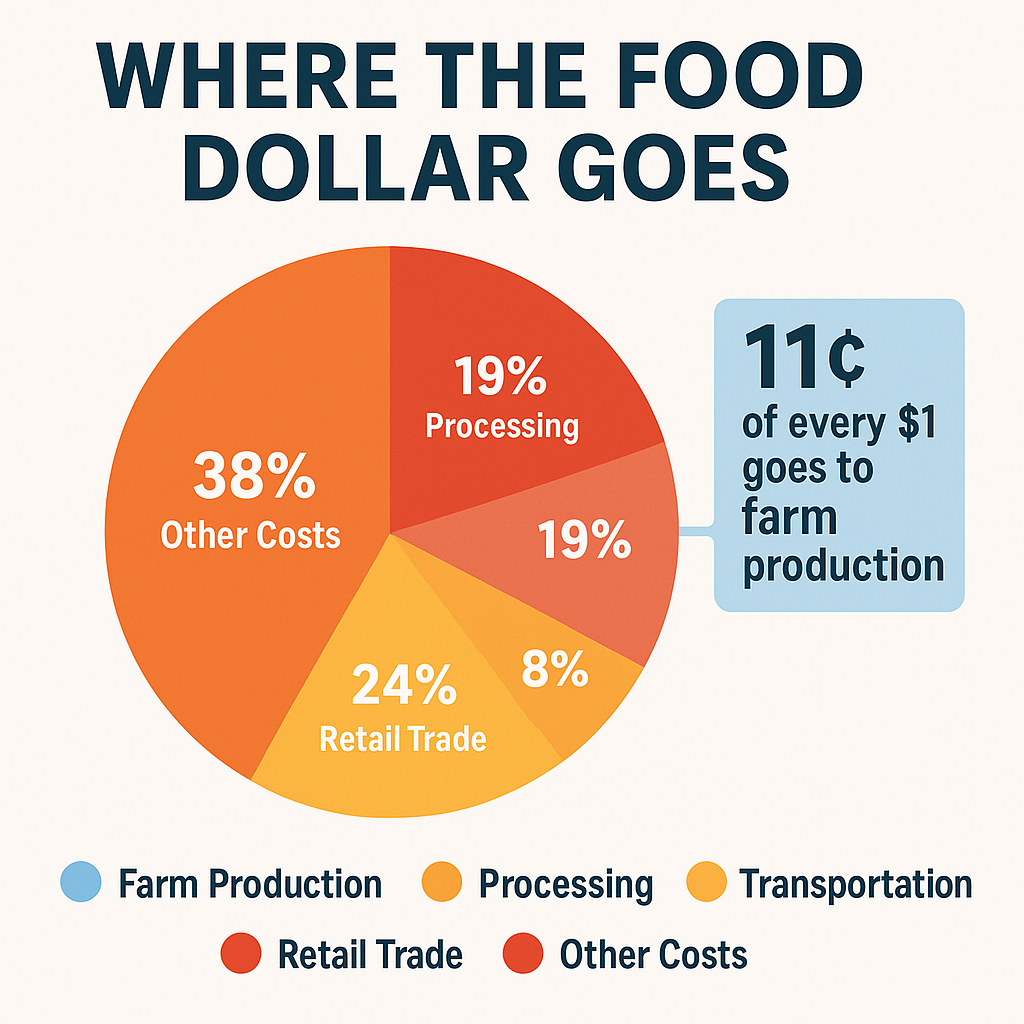
Farmers get pennies on the food dollar.
Even as grocery prices surge, farmers do not see the benefit.
**THE WHEAT VS. CEREAL EXAMPLE
A SIMPLE CASE STUDY IN WHY FARMERS CAN’T SURVIVE**
Consider wheat — grown across the region from Consecon to Norwood to Napanee:
- A farmer earns about $260–$300 per tonne of wheat.
- That tonne of wheat becomes about $7,000 worth of breakfast cereal on store shelves.
- The farmer captures 3%–5% of the final value.
Nearly every farm product follows this pattern:
- Apples vs. grocery store prices
- Corn vs. ethanol and feed margins
- Beef vs. retail meat prices
- Milk vs. supermarket dairy pricing
- Vegetables vs. processed and packaged equivalents
Consumers see rising food prices.
Farmers see almost none of that money.
THE REAL REASONS FARMS DISAPPEAR IN EASTERN ONTARIO
It is rarely because farmers “don’t want to farm.”
It is almost always because they can’t afford to.
The top reasons farms disappear in PEC, Northumberland, Belleville’s rural fringe, and Kingston:
1. Retirement with no successor
The average Ontario farmer is nearly 58.
Most children cannot afford the land or machinery needed to take over.
2. Rising input and tax costs
PEC farmers facing rising taxes sometimes operate in the red for years.
3. MPAC valuations misaligned with actual farm income
In hot real estate markets like PEC and parts of Northumberland, land is valued as if it might become a subdivision — even when zoning prohibits it.
4. Consolidation
Larger operators purchase neighbouring land as older farmers retire.
This keeps land in agriculture but reduces the number of independent farmers.
5. Non-farm buyers
Across Brighton, PEC, and Kingston, a rising share of farmland is purchased for:
- estate lots
- hobby farms
- equestrian operations
- solar development
- lifestyle properties
These aren’t necessarily bad outcomes — but they reduce the number of full-time farmers.
THE FARMLAND DATA IS MISLEADING WITHOUT HUMAN CONTEXT
Statistics Canada counts “actively farmed land,” not total land that could be farmed.
MPAC counts “assessed farmland,” not actual production.
Municipalities count “zoned prime agricultural land,” which may sit idle for years.
So depending on the data source:
- Land might appear “lost” when it’s simply fallow.
- Land might appear “stable” while farmers quietly disappear.
- Land might seem “converted” when only ownership changed, not land use.
This is why PEC’s “3,000 acres lost annually” and MPAC’s “830 acres” can both be technically correct — and both miss the big picture.
EASTERN ONTARIO IS ONE BAD GENERATION AWAY FROM LOSING FOOD SECURITY
Prince Edward County won’t run out of acres.
Northumberland won’t run out of acres.
Belleville’s rural ring won’t run out of acres.
Kingston’s outer townships won’t run out of acres.
But we will run out of:
- Farmers
- Skills
- Local food supply
- Knowledge
- Multi-generation continuity
- Rural economic stability
The question is not “How many acres are we losing?”
The real question is: “How many farmers can afford to continue? And what will happen when they can’t?”
WHAT MUNICIPALITIES AND THE PROVINCE SHOULD DO
A credible, region-wide strategy would include:
1. Reform MPAC for farmland
Assess based on agricultural income potential — not speculative development value.
2. Farm property tax stability
Set multi-year caps or rate smoothing to prevent sudden spikes when reassessments occur.
3. Reduce energy burdens on rural operations
Hydro rate reform for agricultural users would have immediate, measurable impact.
4. Succession planning support
Northumberland and Kingston have strong programs — PEC should adopt similar models.
5. Protect prime farmland intelligently
Not just by stopping subdivisions, but by enabling profitable farming.
6. Strengthen regional food economies
More local procurement by municipalities, schools, hospitals, and long-term care.
7. Recognize agriculture as a high-skill profession
Public discourse must stop painting farmers as “land holders” rather than skilled operators in a globally competitive industry.
THE REAL STORY
The farmland debate is important — but incomplete. In Eastern Ontario, farmland is not the most endangered resource.
Farmers are.
Without addressing the economics of farming, no amount of zoning, mapping, or land-use policy will prevent the real collapse.
A field on a map isn’t a farm. A farmer makes it one.