
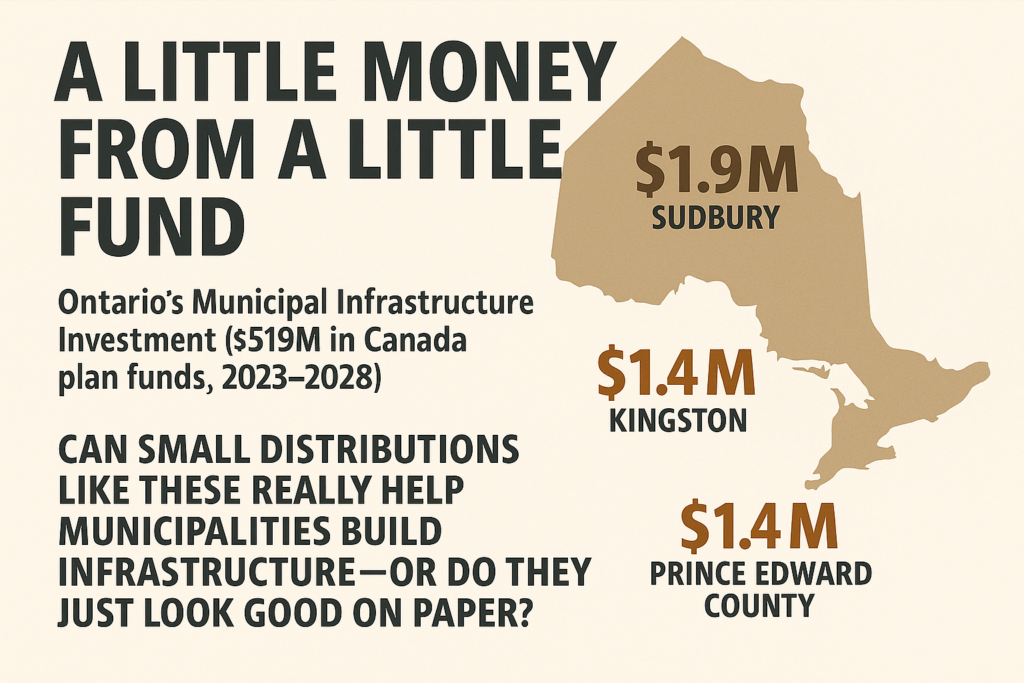
Ontario’s government recently announced $14.9 million in infrastructure funding for Bay of Quinte municipalities under the Ontario Community Infrastructure Fund (OCIF). The headline sounds impressive — until you look closer at the numbers.
Prince Edward County’s share: $1.4 million.
That’s about enough to patch a few rural roads, not rebuild them. For comparison, the County’s single largest road project, County Road 49, carries a repair price tag of $52 million.
So what’s really going on here?
The Fund: A Familiar Political Pattern
The Ontario Community Infrastructure Fund (OCIF) was created in 2014 to help small and rural municipalities repair roads, bridges, water, and wastewater systems. Its intent — to provide predictable annual funding — was sound. But the fund’s scale hasn’t kept up with real infrastructure needs.
- OCIF’s total annual envelope for all 424 municipalities is about $400 million.
- Ontario’s total municipal infrastructure deficit is estimated at $52 billion, according to AMO (the Association of Municipalities of Ontario).
- That means OCIF addresses less than one percent of the problem.
In the Bay of Quinte region, the $14.9 million distributed across multiple municipalities barely moves the needle. Prince Edward County’s $1.4 million would resurface roughly 2 kilometres of County Road 49, or rebuild one aging culvert.
Yet the government’s news release and accompanying photos suggest a major breakthrough in rural investment — a pattern repeated province-wide.
The Political Optics
For Queen’s Park, OCIF is less about solving infrastructure deficits and more about maintaining political visibility in local communities.
The formula is simple:
- Announce a multi-municipal total (“$14.9 million for Bay of Quinte”).
- Ensure the MPP’s photo accompanies each local release.
- Spread amounts widely enough that every mayor can issue a quote of gratitude.
- Repeat the announcement cycle annually.
Each cheque is small enough to keep municipalities dependent but large enough to guarantee a headline.
What $1.4 Million Really Buys
For Prince Edward County, the $1.4 million OCIF allocation covers roughly:
- 2 km of full-depth road reconstruction or
- 1 km of sewer replacement or
- 4 small culvert rehabilitations.
Meanwhile, Shire Hall faces tens of millions in deferred maintenance on roads, bridges, and water systems. The County’s total annual infrastructure gap exceeds $20 million per year.
So while local officials rightly welcome the funding, the reality is that the OCIF cheque covers barely one month of the County’s infrastructure deficit.
Structural Issues: Short-Term Money, Long-Term Needs
The deeper problem is the mismatch between episodic funding and long-term capital planning. Municipalities can’t hire or schedule effectively when money arrives in unpredictable, politicized bursts.
The Auditor General of Ontario has repeatedly warned that ad-hoc infrastructure programs encourage “announcement-driven” spending rather than outcome-based planning. Projects are chosen not because they deliver the best long-term return but because they’re shovel-ready during an election cycle.
OCIF, while marketed as stable, still forces local governments to compete for limited dollars and shape plans around funding eligibility — not engineering logic.
Who Really Benefits?
For the province:
- Political visibility in rural ridings without committing to large-scale investments.
- Positive media coverage for local MPPs who can frame small sums as “historic.”
- Fiscal control — since the fund is small, it doesn’t affect Ontario’s balance sheet.
For municipalities:
- A bit of breathing room, but no ability to address the real infrastructure backlog.
- Continuing dependence on provincial goodwill for basic capital repairs.
For residents:
- Little visible change. Roads remain crumbling, water mains leak, and property taxes rise to fill the gaps.
The CountyFirst View
Prince Edward County, like many small municipalities, doesn’t need applause money. It needs predictable, scalable infrastructure funding tied to asset-management plans, not annual press releases.
A real fix would mean:
- Ten-year infrastructure compacts between the Province and municipalities.
- Funding tied to measurable outcomes — kilometres of road upgraded, bridges rehabilitated, emissions reduced.
- Provincial co-funding for major rural connectors like County Road 49, rather than fragmented micro-grants.
Until then, OCIF remains what it has largely become: a political tool disguised as a partnership.
The County should accept the $1.4 million gratefully — and demand forty times more.