
Word on the Street: Snippets | Belleville| Brighton | Cobourg | Kingston | Napanee | Peterborough | Prince Edward | Oshawa | Port Hope | Quinte West | Toronto

Prince Edward: Word on the Street
What residents of Prince Edward COUNTY Are Really Talking About
A comprehensive review of policy and developments that impact our community.
When the Numbers Stop Making Sense: A Governance Review of Prince Edward County (2022–2026)
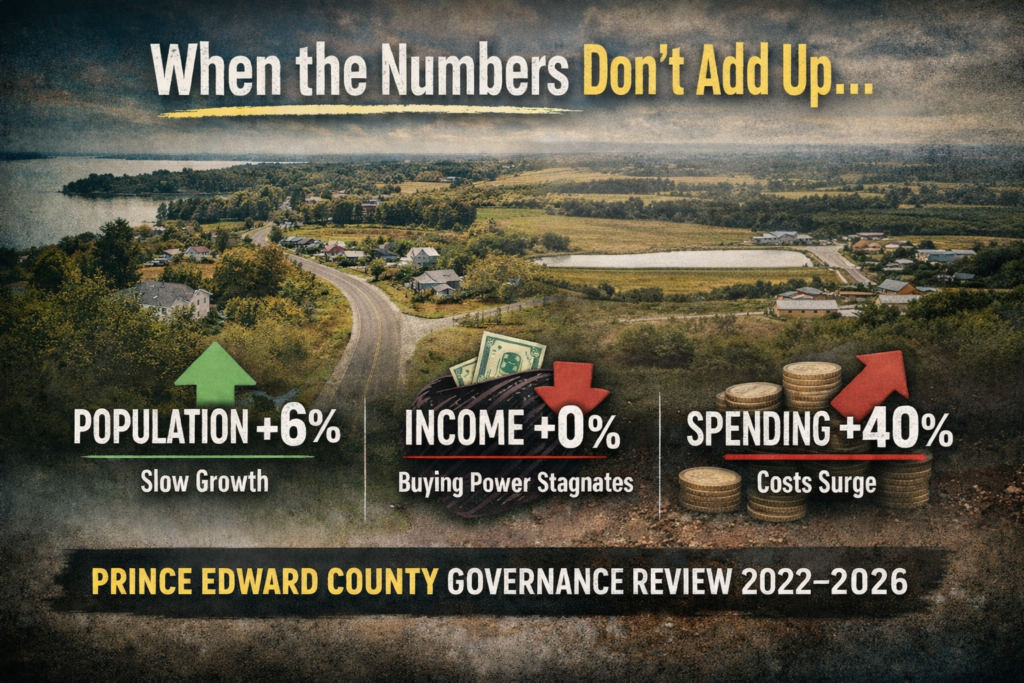
Prince Edward County’s municipal operating budget has increased more than 40 percent over the past decade — roughly five times faster than population growth and significantly faster than household income growth. For many residents, that gap has become increasingly difficult to ignore. Prince Edward County residents are not frustrated because they oppose public services. Public services are essential to community life. The concern expressed by many residents is that municipal spending trends increasingly appear disconnected from everyday economic realities faced by households. Read more.
Audit of the 2022–2026 Council term
As the October 26, 2026 municipal election approaches, the residents of Prince Edward County (PEC) are conducting a rigorous audit of the 2022–2026 term. This Council has presided over a period of unprecedented fiscal volatility, marked by a $90.9 million budget and a debt trajectory that many fear has reached a point of no return. The following report card evaluates the performance of all nine wards, focusing on cost-of-living increases, infrastructure delivery, and the independence of leadership. Read more.
Prince Edward County 2026 Budget Report
Prince Edward County’s 2026 budget is balanced and compliant — but when you look deeper, it raises serious questions about long-term affordability, governance discipline, and accountability. County First has published a detailed, data-driven report comparing PEC to similar Ontario municipalities and tracking trends over the past decade. Read more.
Big Hat, No Cattle: Why Prince Edward County’s growth story needs a reality check
Prince Edward County is not opposed to growth. The issue now facing Council and residents is narrower, but far more consequential: whether the population growth assumptions used to justify major infrastructure spending are realistic, evidence-based, and appropriate for long-term financial commitments. Read more.
Reserve funds in the 2026 budget: What’s missing, and what residents can demand
Prince Edward County’s 2026 budget materials show reserve and reserve-fund transfers in ways that are technically “there,” but often not presented in a single, resident-friendly schedule. That’s why many people come away feeling the amounts are hard to find. The bigger transparency problem: reserve transfers also appear inside departmental operating pages. Here’s what we can confirm from official County budget documents right now, why it matters, and how residents can request full disclosure in a clean, consolidated format. Read more.
Prince Edward County’s 2026 Budget: The Red Flags Hiding in Plain Sight
Prince Edward County Council’s approved 2026 budget reveals a growing disconnect between rising spending and visible service improvement. Residents are being asked to fund a tax-supported operating budget of approximately $88.25 million, with $56.87 million raised locally, yet internal and administrative costs continue to grow faster than accountability mechanisms. Read more.
When Compliance Isn’t Enough: How Prince Edward County’s 2026 Budget Falls Short of the Municipal Act’s Intent
Ontario’s Municipal Act, 2001 sets out more than procedural requirements for municipal budgeting. It establishes expectations for transparency, accountability, financial stewardship, and meaningful public engagement. A municipality can technically comply with the Act and still fail to meet its underlying intent. Prince Edward County’s 2026 budget highlights that gap. Read more.
The Transparency Gap in Municipal Procurement
Building on the recent adoption of the 2026 budget, the discussion around Prince Edward County’s (PEC) procurement policies has shifted from simple “line-item” oversight to a deeper demand for transparency. With contracted services now representing 20% of all municipal spending, the policy governing how these vendors are chosen—and why some are chosen without competition—is under a microscope. Read more.
Follow the Money: MAT, Transparency, and the Growing Accountability Gap
Prince Edward County’s Municipal Accommodation Tax (MAT) was introduced as a modest levy to support tourism-related activity. It is now a seven-figure annual revenue stream with real implications for municipal priorities — yet it remains governed with far weaker transparency standards than many much smaller public programs. Read more.
Why Prince Edward County Must Do More for Youth
Reaching for Rainbows, ROC, and the Front-Line Organizations carrying a growing load while millions spent on administrative growth, tourism promotion and consultants. One of the clearest indicators of a community’s long-term health — how it supports its children and youth — remains under-prioritized in municipal decision-making. Read more.
Time for Renewal: Why Prince Edward County Needs a New Council in 2026
Prince Edward County is at a crossroads. After years of rising taxes, worsening service levels, stalled infrastructure work, and governance failures across critical files — from affordable housing to economic development — residents are increasingly asking a difficult but necessary question: Is this the right council to lead the County into the next decade? A clear-eyed review of council’s performance suggests the answer is no. Read more.
Social media scan: Prince Edward County: Balancing Tourism Growth with Community Needs
In Prince Edward County, social platforms buzz with conversations about tourism growth, local business support, and housing pressures for year-round residents. The island’s charms consistently attract visitors, but many residents note that increasing tourism traffic strains infrastructure and raises housing costs—especially for service workers and young families. Community posts often highlight the need for balanced planning that preserves rural character and lakefront beauty while ensuring affordable living options. Many locals advocate for policy frameworks that encourage mixed-use development without sacrificing natural landscapes.
Agriculture and food security also appear in discussions. Residents share updates about farmers’ markets, craft food events, and initiatives that support local producers. These posts underscore pride in the region’s agricultural heritage but also a desire to protect farmland from overdevelopment. Affordable housing for workers in hospitality, agriculture, and trades remains a recurring theme—sparking debates about accessory dwelling units, rental incentives, and partnerships with developers for community benefit housing. These online conversations reveal a community striving for equilibrium: embracing economic vitality from tourism while fostering a sustainable and inclusive quality of life for year-round residents.
Why Council Should Support the Wellington Town Hall Foundation Proposal
Next week, Prince Edward County Council has an opportunity—arguably a rare one—to make a decision that is fiscally responsible, community-driven, and fully aligned with the municipality’s own asset-management objectives. The proposal from the Wellington Town Hall Foundation (WTHF) to acquire the Wellington Town Hall for a nominal fee and operate it as a self-sustaining arts and wellness hub is not just a “nice idea.” It is a structurally sound, precedent-supported, and financially advantageous plan that reflects exactly what residents have asked for. Importantly, it is a plan vetted by municipal staff, supported by half of council, endorsed by Wellington’s own representative, and built on community consultation already commissioned by council. The remaining question is whether the County will honour the process it started—and whether Councillors Bill Roberts and Sam Branderhorst, who were absent from the previous vote, will recognize the value of this opportunity. This decision is not about sentimentality or nostalgia. It is about good governance. Read more.
Small Money, Big Headlines: The Politics Behind Ontario’s Infrastructure Handouts

Ontario’s government recently announced $14.9 million in infrastructure funding for Bay of Quinte municipalities under the Ontario Community Infrastructure Fund (OCIF). The headline sounds impressive — until you look closer at the numbers. Prince Edward County’s share: $1.4 million. That’s about enough to patch a few rural roads, not rebuild them. For comparison, the County’s single largest road project, County Road 49, carries a repair price tag of $52 million. So what’s really going on here? Read more.
Picton Terminals Study: Big Promises, Bigger Questions
A new report commissioned by the Chamber of Marine Commerce (CMC) and authored by Aviseo Conseil — with support from the Canada Border Services Agency (CBSA) — paints an optimistic picture: if Picton Terminals were to become a customs-cleared container port, it could generate $26.4 million in new business income every year, create steady jobs, and boost local prosperity. It’s an ambitious vision. But beneath the big numbers are serious questions about infrastructure, accountability, and whether Prince Edward County taxpayers could end up footing the bill. Read more.
Approving Growth Without Infrastructure: A Recipe for Crisis in Prince Edward County
Prince Edward County is on the verge of making decisions that could permanently alter its future — and not for the better. At the heart of the issue is a dangerous mismatch between the scale of approved development and the County’s ability to provide infrastructure and services. Consider Picton. The town has a population of roughly 3,000 residents today. Yet the County is preparing to approve projects like Base31, which alone could add as many as 8,000 homes. Imagine that for a moment: a sleepy town tripling in size almost overnight, without the roads, schools, water, or sewer capacity to support it. Read more.
The County Budget Is Outpacing Reality
Why Prince Edward County Needs a Hard Reset — Not Another PR-Driven Tax Hike. Property taxes in Prince Edward County are about to rise again. The draft 2026 budget proposes an 11 per cent increase in the tax levy (about 9.3 per cent after growth), layered on top of several consecutive years of above-inflation increases. Read more.
Time for Transparency: Why Prince Edward County Needs a Lobbyist Registry

Transparency is the foundation of trust in local government, but it is also the area where municipalities most often stumble. Prince Edward County has spent a large portion of its council time in recent months behind closed doors, deliberating on land sales, development disputes, and personnel matters. While many of those sessions are permitted under the Municipal Act, the optics are troubling. To restore public confidence, the County must go beyond the legal minimum and adopt stronger tools of accountability—starting with a lobbyist registry. Read more.
Tourists Are Overloading Prince Edward County’s Cell Service
Canada’s Cell Phone System Is Broken — but Profitable for Cell Phone Companies. Each summer, Prince Edward County’s beaches, wineries, and festivals bring crowds — and a collapse in local cell service. Overbusy towers mean no data and dropped calls, especially on peak weekends when locals say “networks go down”. It’s not just an annoyance; unreliable service in rural Canada remains appalling, especially when many U.S. rural areas enjoy more consistent connectivity. Canadians deserve better. Read more.
Elect Respect in PEC: A Movement to End Harassment in Local Politics
Prince Edward County is taking a stand against harassment and abuse in municipal politics with the launch of Elect Respect in PEC. This grassroots initiative, sparked by Ameliasburgh Councillor Janice Maynard, aims to foster a respectful environment for council members. The movement addresses troubling trends, including personal attacks and online harassment, which have created hostile work conditions for councillors. A resolution passed on July 22 encourages diverse candidates and condemns abusive behavior, reflecting a commitment to healthy democracy.
Monitoring Cold Creek: Ensuring Environmental Integrity in Prince Edward County
Prince Edward County Council has taken a proactive step to safeguard the Cold Creek watershed with the approval of a Terms of Reference (TOR) for monitoring. This decision addresses concerns over the Waring Creek development, a 38-hectare project proposing 119 homes near Cold Creek. The TOR, adopted on July 10, mandates a comprehensive study to assess the development’s impact on water levels, erosion, and aquatic ecosystems, reflecting the County’s commitment to environmental stewardship. Read more.
Sponsored by AI—After Warning You About It?
In its latest newsletter dated August 8, 2025, the Picton Gazette features a paid AI sponsorship promoting income-generation tips using artificial intelligence—just days after publishing opinion pieces warning readers about the risks of AI-generated news and a vicious attack on County First. This contradiction raises important questions about editorial integrity and transparency in local journalism. [Read more]
Editorial: In Response to the Picton Gazette’s “County Fake”
The July 16th editorial published by the Picton Gazette—ironically titled “County Fake”—accuses County First and the Prince Edward County Residents Association (PECRA) of being anonymous, unaccountable, and misleading in our analysis of local media funding and bias in our article: Audit of Media Coverage in PEC. We believe these accusations demand a clear and public response. [Read more]
Doug Ford’s Decision to Cancel the Starlink Contract: A Setback for Ontarians, Especially First Nations
Over 90% of trade between Canada and the United States is conducted tariff-free, illustrating the depth and breadth of economic cooperation that benefits both nations. The Starlink contract’s cancellation underscores broader challenges in Canada’s digital infrastructure strategy, especially in underserved and remote communities reliant on satellite-based internet solutions. Read more.
Water, Heritage, Sandbanks, Theatre & Truth: Your County Briefing
This month’s report brings you deep dives on PEC’s $300M water plan, why residents are walking out of hospitals, and a troubling new editorial direction at the Gazette. Plus, urgent calls to preserve our heritage buildings and support the arts. Read more.
Supply Management: Why This Farming Cartel Harms Most Canadians
Canada’s supply management system—created to stabilize prices and incomes in dairy, poultry, and eggs—is often defended as a fair trade-off. But dig deeper, and it’s clear the system imposes regressive costs on most Canadians while benefiting only a small protected elite. Read more.
Why STRs Need a Sunset Clause: 3-Year Exit Plan for Short-Term Rentals
The Evidence: How STRs Are Fueling Housing Scarcity in PEC. From 2016–2017, approximately 50% of home sales in PEC were tied to short-term accommodation activity. That share dropped to 23.2% by 2020, but nonetheless reflects the heavy influence of STRs on real estate pricing and availability. A municipal advisory noted a staggering $47,760 annual home affordability gap and $318/month rental gap in Picton—partially attributed to STR-driven demand surge between 2019–2021. [Read more]
Taxes in Prince Edward County
Prince Edward County is known for its natural beauty, heritage villages, and agricultural charm. But for many residents—especially seniors, working families, and small business owners—the cost of living here has become unsustainable. The root of the frustration? A mounting combination of taxes and fees that now place PEC among the most heavily taxed communities in Ontario. [Read more]
Inside the Short-Term Rental Boom: Who’s Really Winning?
It’s a Friday evening in mid-summer, and the lights are flipping on across Prince Edward County – not just in homes, but in hundreds of short-term rentals tucked along our shores and village lanes. These Airbnbs and vacation cottages have exploded in number over the past decade, turning the County into one of Canada’s hottest rural destinations. But as tourists revel in chic farmhouses and lakeside lofts for the weekend, many locals are asking: who’s really winning in this boom? We dig into the data and community voices behind the short-term rental surge to find out. [Read more]
Transparency
- Prince Edward County Council: Progress, Challenges, and the Path Forward
- Public Payroll in Focus: Prince Edward County’s Staffing Costs in Context
- Why Accountability at Shire Hall Matters More Than Ever
-> Read more
Healthcare
- The Province’s Legal Responsibility in Healthcare Delivery—and How It’s Failing Prince Edward County
- Shifting Sands: How Prince Edward County’s Population Is Changing
Infrastructure
- Open letter to Mr. Tyler Allsopp, MPP, Bay of Quinte on road infrastructure
- The Cost of Growth: Why Prince Edward County’s Development Policies Are Failing Residents
- The Hidden Cost of Crumbling Roads in Prince Edward County
- Who’s Responsible for Our Roads? Holding the Province Accountable for Municipal Infrastructure Funding
- Public Transit in Prince Edward County: A Growing Need
Planning
- Why Prince Edward County Must Ban Short‑Term Rentals: A Data-Driven Case for a 3‑Year Sunset Plan
- Shifting Sands: How Prince Edward County’s Population Is Changing
- Port Picton Zoning Review Raises Alarm Over Potential MZO Use
- Prince Edward County: A Municipal Budget Outlier Among Ontario Communities
- Emergency Preparedness in Prince Edward County: A Call for Action
- Municipal Councillor Compensation in Ontario: Assessing Prince Edward County’s Position
- Tourism’s Hidden Cost
- How Reliable Is Our Emergency Response in Rural Prince Edward County?
- Ten-Point Recommendation for a Green Strategy in Prince Edward County
Taxes
- Why Prince Edward County Needs a Stronger Industrial Tax Base
- Property Tax Growth in Prince Edward County
- The Hidden Toll of the Municipal Accommodation Tax on County Tourism
County Life
Haunted PEC: True Stories from Ghost Tours
When darkness falls over Prince Edward County in late October, the veil between past and present seems to thin. On dimly lit lanes and in creaking old houses, stories of restless spirits find eager ears. We tagged along on one of PEC’s popular ghost tours – the Graveyard & Gallows Walking Tour in Picton – and gathered other local ghost lore to bring you true (and [truly spooky) tales from The County’s haunted history. Light your lantern and prepare for goosebumps as we recount the spectral legends that still linger in our quiet corner of Ontario. [Read more]
Hidden Gems: PEC’s Forgotten Artisan Villages
Lace up your boots and grab a County map – we’re detouring off the wine-and-beach trail to discover Prince Edward County’s hidden artisan villages. Beyond bustling Picton and trendy Wellington, quiet hamlets like Consecon and Milford are nurturing creative revivals that many visitors miss. These “forgotten” villages, once hubs in the 1800s, are finding new life as artisans’ enclaves, proving that The County’s charm runs on its backroads as much as its Main Streets. [Read more]
Ontario News
Ontario’s Permitting Bureaucracy: A Slow Grind Against Economic Progress
There’s an old saying in government affairs: if you want something done slowly, regulate it. If you want it stopped entirely, send it through Ontario’s permitting system. For small businesses, tradespeople, and developers alike, navigating the province’s increasingly bloated permitting apparatus has become less about compliance—and more about endurance. From building permits to environmental assessments to licensing reviews, Ontario’s regulatory ecosystem has grown into a Kafkaesque machine: opaque, inconsistent, and increasingly self-reinforcing. [Read more]
Ontario Insurance Premiums Soar Past Inflation — and Far Above Global Norms
While inflation in Canada hovers at just 1.75%, insurance premiums in Ontario are skyrocketing—up 12% for auto insurance and 11% for home insurance in 2025. These sharp increases have prompted concern among residents already grappling with a high cost of living and stagnant wage growth. But the story becomes even more troubling when compared internationally: Ontario’s insurance costs and their rate of increase are among the highest in the developed world. [Read more]
GTA’s New Subdivisions Are Turning into Ghost Towns: “No Buyers. No Renters.”
A recent post on X (formerly Twitter) declared bluntly: “Coming soon to GTA suburbs: brand new subdivisions turned ghost towns. No buyers. No renters. Just rows of empty homes and no one coming.” This reflects warnings heard in real estate circles—and firsthand reports from Reddit users, who describe recently completed but unsold housing developments in areas like Niagara and Halton Region, noting entire neighbourhoods with empty houses. [Read more]
Canada News
Will Canada Be Forced to Scrap Supply Management for a U.S. Trade Deal?
The Context: Canada-U.S. Trade Tensions Heat Up. In June 2025, Canada abruptly repealed its Digital Services Tax, which targeted U.S. tech giants like Google and Meta — a move widely seen as a concession to President Trump. That same week, trade talks with the U.S. were abruptly resumed following threats of major tariffs on Canadian steel, aluminum, and auto exports. Amid these shifting negotiations, speculation has surged on platforms like Reddit and op-eds lamenting that Prime Minister Mark Carney may soon be pressured to dismantle Canada’s supply management regime for dairy and poultry—once again trading domestic food policy for favorable trade terms with the U.S. [Read more]
GTA’s New Subdivisions Are Turning into Ghost Towns: “No Buyers. No Renters.”
What’s Happening? A recent post on X (formerly Twitter) declared bluntly: “Coming soon to GTA suburbs: brand new subdivisions turned ghost towns. No buyers. No renters. Just rows of empty homes and no one coming.” This reflects warnings heard in real estate circles—and firsthand reports from Reddit users, who describe recently completed but unsold housing developments in areas like Niagara and Halton Region, noting entire neighbourhoods with empty houses. [Read more]
Canada Falls from “Safe 8”: Millionaire Migration Collapses by 69 % in 2025
Migration Metrics: Wealth Fleeing Canada. According to the Henley Private Wealth Migration Report 2025, global millionaire relocations have surged—with 142,000 individuals expected to move internationally in 2025. Yet Canada’s net inflow of wealthy migrants is plummeting, with only about 1,000 new arrivals projected—a 69 % decline compared to the previous year, now placing Canada outside the prestigious “Safe 8”. This represents record-low appeal among early retirees and investors seeking stable, welcoming destinations. [Read more]
Canadian Retirees in Distress: How HELOC-Funded Mexico Dreams Turned Sour
HELOCs: How Canadians Funded Mexican Retirement Escapes. A growing number of Canadian retirees have tapped into home equity lines of credit (HELOCs)—many in the multimillion-dollar range—to buy retirement or vacation properties in Mexico. These purchases were often made under the belief that property values would continue to rise—and that Mexican real estate offered better returns than staying in Canada. [Read more]
World News
America’s Debt Crisis: What It Means for Canada & the Global Economy.
U.S. Fiscal Outlook: Debts, Deficits & Everything In Between. With the new $7-trillion federal budget now law, the U.S. stands on a precarious fiscal path:
- Annual Spending: ~$7 trillion; Revenues: ~$5 trillion → Deficit: ~$2 trillion (≈ 7% of GDP)
- Debt Held by the Public: over 100% of GDP ($33 trillion total); per household: ~$230,000
- In 10 years: Debt projected to hit ~130% of GDP, with per-household debt around $425,000. That means government debt will rise from 6× revenue today to 7.5× by 2035
- Interest expenses will double—from ~$1 trillion today to ~$2 trillion annually—driving total debt service to over $18 trillion/year.
How China leveraged Canadian climate policy to dominate critical industries while Ottawa looked the other way
“I’d rather betray the world than let the world betray me.” – Cao Cao. Canada’s climate policy has long been heralded as progressive, principled, and world-leading. But what if the very policies that were meant to protect our planet have been hijacked by a foreign power with no intention of reciprocating the sacrifices we’ve made? In the wake of testimony in the United States Senate alleging Chinese Communist Party (CCP) influence in the funding of Western climate activism and litigation, it is time Canadians take a sober look at what the global energy transition has meant for Canada’s own strategic interests. [Read more]
U.S. Reciprocal Tariffs: What to Expect
Starting 12:01 AM EST on July 9, the U.S. reinstated country-specific reciprocal tariffs ranging from 11% to 50%, unless bilateral agreements are finalized. While deal frameworks with the UK, China, and Vietnam have been announced, most negotiations remain unresolved. [Read more]