
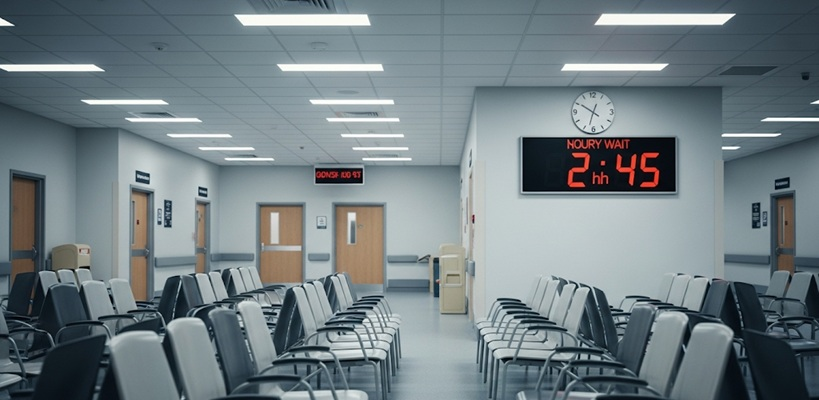
Rising ER Wait Times in Ontario
Ontario’s emergency departments are experiencing significantly longer waits than in the past. In the 2022/23 fiscal year, patients waited on average about 118 minutes from triage to see an ER physician, which is roughly 30 minutes longer than a decade prior. Even more troubling, the sickest 10% of patients (90th percentile) waited over 4 hours (257 minutes) for initial assessment, up from about 3 hours (183 minutes) in 2013/14. These delays extend further when a patient needs hospital admission: recent data show
Ontario patients admitted via ER spent over 22 hours on average waiting for a hospital bed, with only 23% of patients getting admitted within the target time of 8 hours. Such waits far exceed recommended benchmarks – some hospitals have reported average waits as high as 22 hours, nearly three times the recommended targets for ER-to-bed transfer.
Wait times vary widely across the province. Regional data reveal stark disparities: for example, patients in Eastern Ontario’s Champlain region waited 169 minutes on average, more than twice as long as those in the Central region (79 minutes). Individual hospital performance also ranges dramatically. During a recent audit, Windsor Regional Hospital’s Metropolitan Campus had an average physician wait of about 247 minutes (over 4 hours), five times longer than the 45-minute average at Etobicoke General Hospital in Toronto. Hospital administrators in Windsor cited a lack of primary care availability (especially on evenings and weekends) as a major reason for their long ER waits – many patients were coming to ER for issues a family doctor could treat, or for access to diagnostics, because no other care was accessible. By contrast, larger urban centres with greater resources (and perhaps more alternatives for care) tended to manage shorter waits. The net effect is a system where when and where you seek emergency care in Ontario can drastically change your wait time.
Patients Leaving Without Being Seen
Long waits have led to a surge in patients who leave the ER without receiving care. Ontario’s “left without being seen” (LWBS) rate averaged 5.3% of ER visits in 2022/23, according to the Auditor General. Some hospitals saw extraordinarily high walkout rates – at one hospital, about 14% of ER visitors gave up and left before a doctor saw them. (Notably, that same hospital had one of the longest wait times, ~175 minutes to see a physician.) This is a worrying trend: by comparison, about 3% of patients left untreated in the early 2000s, and the rate rarely exceeded 4% pre-pandemic. Since 2020, LWBS rates have spiked, frequently surpassing that 4% threshold as overcrowding and delays worsen.
Walking out of the ER is not a risk-free choice. A recent ICES study found that patients who leave without being seen have a 14% higher risk of death or hospitalization within 7 days compared to those who stayed for treatment. The lead author noted that “there are many reasons why people choose to leave the emergency department, but it’s usually about wait times,” underscoring how excessive delays drive frustrated patients away. Crucially, many who left were relatively young (median age 41) and had no recent hospitalization history – in other words, they might have appeared low-risk, yet outcomes prove leaving was often unsafe. Researchers cautioned that these events “should not be considered benign,” especially now, given the overall strains on the system: rising ER volumes, ongoing rural ER closures, inadequate long-term care beds, staffing shortages, and poor primary care access all intersect to make today’s emergency care environment more perilous. In short, ER walkouts are increasing in Ontario, a symptom of system overload that not only represents unmet medical needs, but also can carry severe health consequences.
Urban vs. Rural: A Gap in Emergency Access
Regional and rural/urban divides have become apparent in Ontario’s emergency care. Smaller rural hospitals have been hit hardest by ER service disruptions. In 2024, Ontario saw a record number of ER closures – a CBC analysis found 1 in every 5 hospitals with an ER or urgent care had to temporarily shut down at least once that year, the vast majority of them in rural communities. Between July 2022 and June 2023 alone, emergency departments across Ontario were forced to close 203 times at 23 different hospitals, mostly in rural and northern areas, due to lack of staff. Each closure can leave an entire town without local emergency services. This is more than an inconvenience: as Ontario’s Auditor General noted, when a rural ER shuts its doors, residents face longer travel to the next hospital – and the health risks increase with every extra minute of travel time. In emergency care, distance can be deadly.
Even when rural ERs remain open, many operate with limited hours or tenuous staffing. For example, the small community hospital in Chesley, ON has faced chronic ER closures since 2022 and can now only stay open from 7 a.m. to 5 p.m. on weekdays. Residents there describe never knowing if their only emergency room will be open when a crisis strikes. Other rural hospitals have avoided outright closure by leaning heavily on temporary staff. Ontario’s Emergency Department Locum Program, meant as a last-resort stopgap, saw usage skyrocket – providing over 60,000 hours of physician coverage in 2022/23 (more than double the hours from 2018/19) to prop up understaffed ERs.
A dozen small hospitals have relied on at least 500 locum hours every year, with a couple needing over 1,000 hours annually, just to keep ER doors open. This heavy reliance on visiting doctors reflects how severe the local physician shortages have become in some communities. Hospital leaders admit many rural ERs would be frequently closed without stopgap locums filling shifts. It’s a stark illustration of the urban-rural gap: while big-city hospitals struggle with crowding, small-town hospitals struggle just to stay open.
Prince Edward County is one community emblematic of these challenges. Its local hospital (PECMH in Picton) handles roughly 20,000 ER visits a year, serving a mix of rural residents and seasonal tourists. Staff and patients there report that “volumes of patients…are higher than pre-COVID and expected to continue,” often running well over 100% capacity on inpatient units. Like many areas, Prince Edward County has an older population and a shortage of primary care providers, leading more people to seek care at the ER. “The reasons are many – more elderly patients with complex health issues, an increased number of patients without a family doctor, and delayed care during the pandemic,” explained a Quinte Health official, noting that discharging patients is also hard when home care and long-term care are strained. In short, rural communities such as Prince Edward County are facing a multifaceted crunch: they must care for more (and older) patients with fewer local doctors and an overstretched workforce, all in facilities that haven’t expanded with demand. The result can be long wait times even in a small-town ER, and the ever-present worry of diversion or closure if a single nurse or physician shift can’t be covered. Residents of these areas are increasingly vocal, organizing town halls and even protests to demand better support. They’ve called for solutions like extending small ER hours and bolstering local clinics, because they see clearly that rural Ontarians are at risk of falling through the cracks of an unstable emergency care network.
Key Drivers Behind ER Waits and Walkouts
Multiple factors are fueling Ontario’s ER wait time crisis and the rise in patient walkouts. Experts point to a “perfect storm” of systemic issues straining emergency departments:
- Critical Staffing Shortages: Hospitals across Ontario are grappling with a shortage of nurses, physicians, and other ER staff, which limits how many patients can be treated in a timely manner. The Ontario Hospital Association warns that “sustained pressure” on ERs is linked to staffing shortfalls even as patient volumes surge. The Canadian Medical Association (CMA) likewise cites nationwide ER overflow caused by “staffing shortages, overcrowding” and inadequate primary care access. In practice, too few nurses on duty means fewer triage stations and longer queues, and too few doctors mean patients wait hours longer to be seen. Staffing gaps have even led to temporary ER shutdowns when no physician or nurse coverage was available. Beyond raw numbers, burnout is exacerbating the human resource crunch – frontline providers describe “an epidemic of moral injury, burnout and demoralization” after years of relentless demand. Many experienced nurses have left the profession, and Ontario has seen a “massive exodus” of family doctors, increasing the strain on those who remain. Recruiting and retaining healthcare workers (especially in hard-to-serve rural areas) remains a critical challenge for stabilizing ER services.
- Inadequate Access to Primary Care: A long-standing shortage of family doctors and clinic access is directly contributing to ER overcrowding. When people cannot get timely care from a GP or walk-in clinic, they end up in emergency rooms for non-emergency problems. A recent CMA survey found 1 in 5 Canadians have no family physician at all. The Auditor General noted that in Ontario about 23% of ER visits are for lower-acuity issues (like minor infections) that might have been handled in a doctor’s office – but many of those patients said the ER was their only immediate option or they had no primary care provider available. In fact, only 41% of Ontarians in a pre-pandemic survey could get a primary care appointment within 48 hours. The consequence is predictable: emergency departments become the de facto safety net for basic healthcare. Quebec’s health minister recently observed that almost half of daily ER visits in that province are for non-urgent ailments that could be seen in primary care – if only patients could get an appointment. This inappropriate use of ER resources for primary care needs overwhelms triage systems and lengthens waits for everyone. Health leaders stress that bolstering primary care is essential; as CMA President Dr. Kathleen Ross put it, ERs should not serve as substitutes for walk-in clinics or family doctors.
- Overcrowding and ‘Bed Blockers’: Emergency departments are busier now than ever, and much of that volume is acutely ill patients who require lengthy care. Nationwide, ER visits have rebounded to pre-pandemic highs – over 15.1 million visits in 2022-23 across Canada (up from 14 million the year prior) – and in Ontario many hospitals report record-high ER traffic. The mix of patients is also skewing more complex and ill. Dr. Ross notes “increasing acuity levels of patients” coming to ERs, especially as older adults with chronic conditions grow in number. Once patients are in the ER, they often cannot be moved out due to lack of inpatient beds. This is known as access block or hallway medicine: hospital wards are full, so admitted patients back up into the ER, sometimes for days. Doctors on the front lines say this is now the biggest factor driving ER wait times – not simply the lack of ER staff, but the bottleneck of ward beds and spots in long-term care. Ontario Hospital Association data from winter 2023 showed over 6,000 hospital beds were occupied by patients who should be in more appropriate settings (e.g. awaiting long-term care or rehab). These patients, often called “ALC” (alternate level of care), leave fewer beds for new admissions, so incoming ER patients requiring admission languish on stretchers in hallways. It’s common now to see dozens of admitted-but-boarded patients in a single ER, cared for by ER staff for many hours, which ties up nurses and space. This gridlock leads to alarming scenes: “We’ve got people dying in waiting rooms because we don’t have a place to put them,” says Dr. Michael Howlett of the Canadian Association of Emergency Physicians, referring to the extreme outcomes of overflow. In short, the hospital throughput problem (too few staffed beds for the volume of patients) directly translates into longer ER stays and higher chances that incoming patients will get tired of waiting and leave.
- Triage Delays and Process Inefficiencies: When ERs are understaffed and overcrowded, delays occur at every stage of the patient journey – including the triage stage. Many Ontario hospitals have reported scenarios where patients even wait over an hour just to be triaged, because the initial intake nurse is overwhelmed by the volume. Triage is intended to rapidly prioritize the sickest patients, but if there are not enough nurses at the triage desk or the waiting room is overflowing, this first assessment can be delayed, causing a cascade of bottlenecks. A study from a Canadian hospital found that patients who waited ≥2 hours just to be triaged were far more likely to leave without being seen out of frustration. Additionally, once triaged, lower-acuity patients may still wait hours for a doctor while higher-acuity cases get prioritized. Ontario data confirm that evenings tend to be the busiest, and if a surge of ambulance arrivals or a critical case happens, the queue for others can grind to a halt. Some hospitals have tried innovations like “physician-in-triage” or fast-track units for minor cases to reduce delays, but these require adequate staffing to implement. In many ERs, triage and registration systems are simply straining under the load, contributing to longer wait times and dissatisfaction.
- Population Changes and Seasonal Surges: Ontario’s rapidly growing and aging population is another driver behind ER pressures. The province has seen a “huge spike in population growth in recent years, [and] a growing population of elderly people with complex health needs”, which is increasing demand for health services, the Ontario Hospital Association reports. More people naturally means more ER visits, and older patients often require longer assessments and are likelier to be admitted. Compounding this, seasonal surges of illness put periodic strain on ER capacity – for instance, during the 2023/24 winter, flu, COVID-19, and RSV infections flooded hospitals. In mid-January 2024, Ontario hospitals were treating 1,274 COVID patients, 445 flu patients, and 158 RSV patients simultaneously. These waves of respiratory illness can overwhelm ERs with both genuine emergencies (like severe respiratory distress) and moderately ill patients who nonetheless seek ER care. “During respiratory illness season, we see surges…with more patients than we can treat at any given time,” Dr. Ross explains. Such surges also exacerbate staffing woes, as healthcare workers themselves fall ill, further reducing available personnel. The net effect is an ER system that, at peak times, operates beyond 100% capacity for extended periods. (For example, Quebec’s ERs hit an average of 137% capacity in late 2023.) These conditions are “clearly unsustainable and, quite frankly, dangerous,” in Dr. Ross’s words, because the system cannot reliably absorb additional shocks.
All these factors are interlinked. A shortage of family doctors drives more patients to ER; those patients add to overcrowding; overcrowding, combined with inadequate staffing and beds, leads to longer waits and more people leaving without care. Those walkouts in turn can result in worsening health outcomes and re-presentations to the hospital in even worse condition. It’s a vicious cycle that has been years in the making.
System Pressures and Sustainability: Expert Commentary
Healthcare professionals and analysts are increasingly sounding the alarm that Ontario’s emergency care situation has reached a breaking point. “I’ve worked in emergency departments since 1987, and it’s by far the worst it’s ever been. It’s not even close,” says Dr. Michael Howlett, president of CAEP (Canadian Association of Emergency Physicians). Front-line ER doctors describe daily scenes that would have been unthinkable a decade ago – patients being resuscitated on ambulance stretchers or the floor for lack of an open bed, and waiting rooms so full that some seriously ill people deteriorate before they can be seen. The CMA has warned that without major systemic changes, these problems will keep unfolding and patients will continue to suffer. In some documented cases, Canadians have even died while waiting to be seen in the ER, a tragic outcome of care delayed too long.
Hospital leaders stress that the current situation is putting enormous strain on staff as well. Burnout and morale are at low points. “We’re seeing…demoralization amongst our nurses, paramedics, and physicians,” notes Dr. Adil Shamji, an ER physician and Ontario MPP, who also points to “uncontrollable underspending” on health care as contributing to the crisis. The financial under-resourcing of Ontario’s health system has been flagged by the Financial Accountability Office (FAO), which found the province is **projected to spend $21.3 billion less on health programs by 2028 than what would be required to maintain current services. Such shortfalls raise questions about the long-term sustainability of emergency services if investments aren’t ramped up.
The consensus among experts is that Ontario (and Canada at large) must urgently “rebuild” and reimagine its approach to health care delivery. Solutions being called for include bolstering team-based primary care (to divert non-urgent cases away from ERs), expanding hospital capacity (more staffed beds and facilities where needed), and aggressive health human resources strategies to recruit and retain doctors, nurses, and paramedics. There is also a push for better integration of services – for example, ensuring long-term care and home care can accommodate patients promptly, so that hospitals aren’t stuck holding patients who no longer need acute care. In the interim, stopgap measures like funding additional ER hours, keeping urgent care centers open later in underserved areas, and leveraging virtual emergency consults have been suggested to mitigate the crunch.
Ontario’s emergency care challenges are mirrored in other provinces and indeed put Canada in a poor light compared to international peers. Surveys by the Commonwealth Fund have consistently found that Canada has among the longest ER wait times in the developed world – in one comparison, 29% of Canadians reported waiting 4+ hours in emergency departments, versus just 1% in France (and an 11% average among peer countries). While countries like the U.K. set targets to see and admit or discharge ER patients within 4 hours, Ontario struggles to admit even a quarter of patients within 8 hours. The COVID-19 pandemic’s aftershocks – from treatment backlogs to workforce attrition – have made these problems more acute globally, but Canada’s starting point was already one of the worst for timely access.
Despite the grim indicators, those on the front lines continue to advocate for change. As Dr. Ross of the CMA emphasizes, no one should consider the current state of affairs acceptable or inevitable. “This situation is clearly unsustainable and, quite frankly, dangerous,” she warns, referring to the combination of sustained pressures on ERs and chronic staffing challenges. Researchers echo that sentiment: “Our universal health care system urgently needs significant investment of resources to support both emergency and primary care, in order to meet the needs of our growing, aging, and increasingly medically complex population,” wrote ICES scientists in late 2024. The call to action from experts is unanimous – without swift and substantial interventions, ER overcrowding and patient walkouts will continue to grow, undermining the accessibility and quality of health care that Ontarians expect. The challenge now is for policy-makers and health system leaders to heed these warnings and implement solutions before more cracks in the emergency system turn into breaking points.
Sources:
- Office of the Auditor General of Ontario – Emergency Departments Audit 2023
- ICES (Institute for Clinical Evaluative Sciences) – News Release on ER Walkouts (Dec 2024)
- CBC News analysis (2024) via Grey Bruce Health Coalition; CBC News (Chesley ER example)
- Global News (Ontario Hospital Association statement, Jan 2024)
- Global News (CMA emergency room crisis, Jan 2024)
- CityNews Toronto (ER doctors on wait time crisis, Jan 2024)
- CMA “Healthcare For Real” explainer on ER Waits (2023)
- Prince Edward County Memorial Hospital Foundation blog (local perspective)
- Additional data from CIHI and MOH via media reports