
A FULL-PAGE ADVERTISEMENT MAKES THE CASE FOR SIX PICKLEBALL COURTS. TAXPAYERS SHOULD ALSO SEE THE EVIDENCE BEHIND SOME OF ITS BIGGEST CLAIMS.
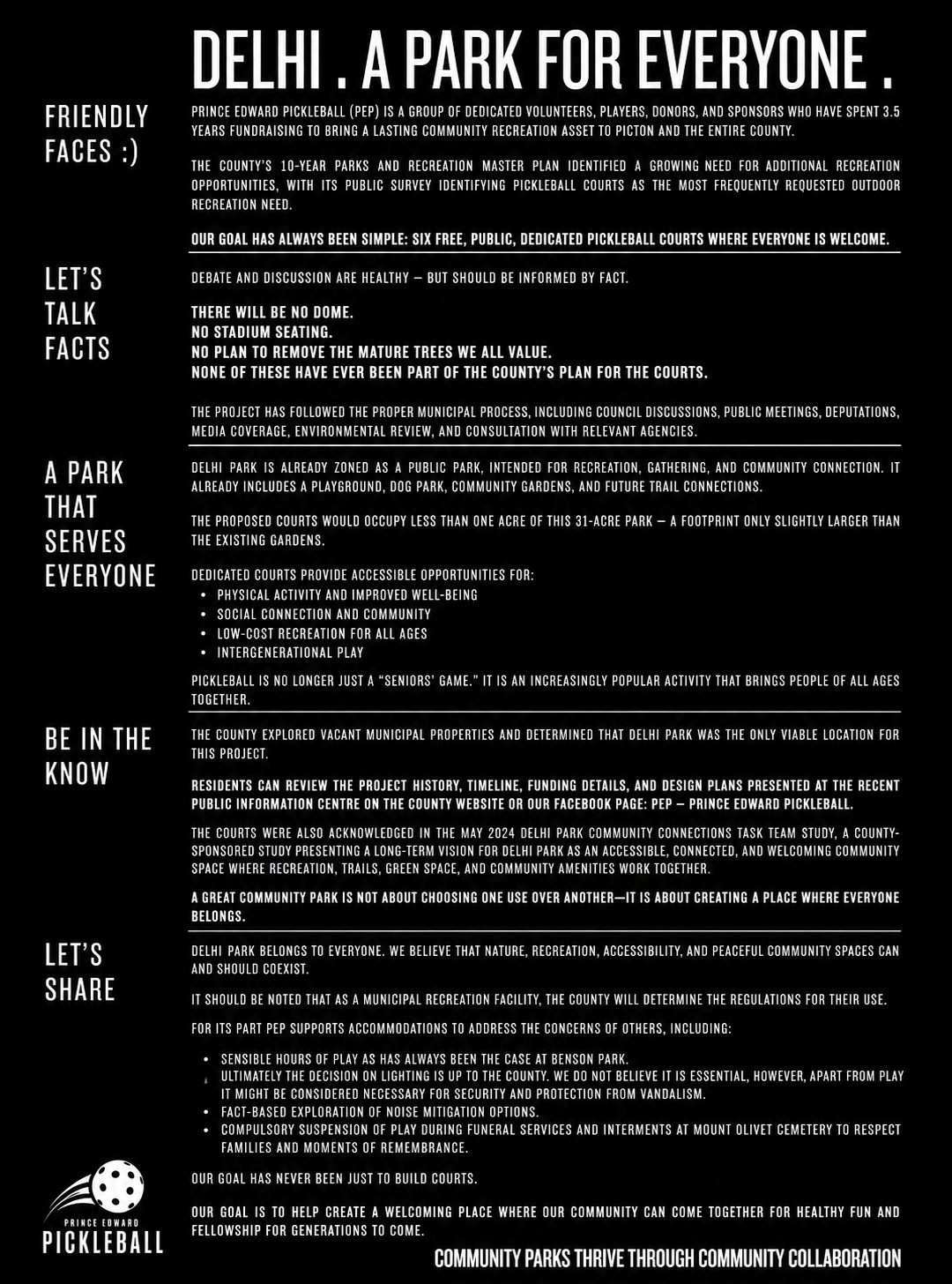
Prince Edward Pickleball has published a full-page advertisement promoting its proposal for six free, public, dedicated pickleball courts at Delhi Park.
The advertisement presents a straightforward argument: pickleball is increasingly popular, the courts would occupy less than an acre of the 31-acre park, Delhi Park serves multiple recreational purposes, and the organization believes nature, recreation and other community uses can coexist.
Those are legitimate arguments. But this is advocacy material. Its purpose is to persuade. Residents and Council therefore need to consider not only what the advertisement says, but what remains unanswered. And one claim in particular deserves documentation.
“THE ONLY VIABLE LOCATION”
The advertisement states:
“The County explored vacant municipal properties and determined that Delhi Park was the only viable location for this project.”
That is a consequential statement. If Delhi Park truly was the only viable municipal property, there should be a documentary basis for that conclusion.
- Which municipal properties were considered?
- What criteria were used to determine viability?
- Were potential locations scored against those criteria?
- Who conducted the evaluation?
- When was it conducted?
- Were noise, parking, traffic, neighbouring residential uses and environmental considerations included?
- Why was each alternative rejected?
- Was the conclusion formally presented to Council?
These questions don’t establish that the statement is incorrect. They are the information taxpayers need to assess whether it is correct. If a site-selection analysis exists, the County should publish it.
WHAT WILL TAXPAYERS ULTIMATELY PAY?
The advertisement directs residents elsewhere for funding details but doesn’t provide the complete financial picture on the page. Construction cost is only one component of a municipal recreational asset. If the courts become a County facility, residents should know both the initial municipal contribution and the expected lifecycle costs. Those can include maintenance, resurfacing, grounds work, garbage collection, insurance, security, washroom requirements and eventual reconstruction or replacement. Private fundraising can substantially reduce the initial burden on taxpayers. It doesn’t necessarily eliminate future municipal costs. Council should therefore publish the anticipated County contribution and reasonable estimates of ongoing costs before approving a permanent facility.
HAS NOISE ACTUALLY BEEN STUDIED?
The advertisement says PEP supports a:
“Fact-based exploration of noise mitigation options.”
That wording deserves attention.
Exploring mitigation options is not the same as having completed an acoustic assessment demonstrating the expected effect on surrounding properties. Six dedicated pickleball courts can produce concentrated recreational activity. The relevant questions are straightforward: Has a professional acoustic assessment been completed? What assumptions were used about hours and court utilization? Where were sound levels modelled? What mitigation was recommended?
If such a study exists, residents should be able to review it. If one hasn’t been completed, Council should consider whether it needs that evidence before settling the location.
THE CEMETERY QUESTION
The advertisement also says PEP supports:
“Compulsory suspension of play during funeral services and interments at Mount Olivet Cemetery to respect families and moments of remembrance.”
The accommodation is significant because it acknowledges a potential conflict between recreational activity and cemetery operations.
But it creates practical questions.
- Who determines when play stops?
- Who communicates funeral schedules?
- Who is responsible for clearing or quieting six courts?
- How long does the suspension last?
- And what consideration is given to people visiting graves outside scheduled funerals and interments?
These aren’t arguments against pickleball. They’re operational issues created by locating an active recreational facility near a cemetery. Council should have answers before the courts are built.
LIGHTING HASN’T NECESSARILY DISAPPEARED
The advertisement says:
“Ultimately the decision on lighting is up to the County. We do not believe it is essential.”
That is different from saying there will be no lighting.
If Council approves the project without lighting, residents should know whether lighting could subsequently be installed and what public process would be required before that happened. Hours of operation should similarly be established transparently.
WHAT ABOUT PARKING AND TRAFFIC?
The advertisement emphasizes that the courts would occupy less than one acre of a 31-acre park. But percentage of acreage doesn’t necessarily measure practical impact.
Six courts can accommodate numerous players simultaneously, with additional people arriving, leaving or waiting to play. Residents should therefore be shown the anticipated parking demand, available capacity, expected peak usage, overflow arrangements and any traffic assessment undertaken for the proposal. Where the courts sit within those 31 acres matters considerably more than the percentage of total parkland they occupy.
WHAT WAS THE “ENVIRONMENTAL REVIEW”?
The advertisement says the project has undergone “environmental review.” That sounds reassuring, but residents need enough information to understand what the phrase means.
- Who conducted the review?
- What was its scope?
- Did it examine trees, habitat, drainage, stormwater, construction impacts, noise or lighting?
- Were recommendations made?
Again, if the documentation exists, publish it.
WHO CONTROLS THE COURTS AFTERWARD?
PEP describes six “free, public, dedicated pickleball courts” and correctly notes that, as a municipal recreational facility, the County would determine regulations governing their use. Residents should nevertheless understand the proposed governance arrangement.
- Would PEP have preferred booking periods, tournament access, programming rights or any continuing operational role?
- Would courts always be available on an equal basis to the general public?
The answers may be entirely straightforward. They should simply be documented.
“A PARK FOR EVERYONE”
The advertisement’s headline is:
“Delhi. A Park for Everyone.”
It later argues:
“A great community park is not about choosing one use over another — it is about creating a place where everyone belongs.”
That’s an appealing sentiment.
But dedicating part of public parkland to six permanent courts necessarily involves a choice about how that land will be used. That doesn’t make the choice wrong. It means Council should determine whether this particular recreational use, at this particular location, represents the best use of that portion of a public asset.
THIS ISN’T A REFERENDUM ON PICKLEBALL
That distinction matters. Residents can support pickleball and still question the proposed location. They can support additional recreation while asking about noise.
They can appreciate private fundraising while asking about future taxpayer costs. They can support Delhi Park while questioning whether six dedicated courts are its best use. And they can support the volunteers behind Prince Edward Pickleball while expecting the County to independently scrutinize the proposal. Those positions aren’t contradictory. They’re what responsible municipal decision-making looks like.
SHOW THE PUBLIC THE RECORD
The most useful next step isn’t another round of competing slogans. It’s disclosure.
Before a final decision, the County should make readily available the documentation underlying the proposal: site-selection analysis and alternatives considered; project capital and lifecycle costs; noise assessment or related technical work; parking and traffic analysis; environmental review; proposed operating rules; lighting plans or restrictions; and the respective future responsibilities of the County and PEP.
Then residents can evaluate the proposal on the same evidence available to decision-makers.
The advertisement itself says:
“Debate and discussion are healthy — but should be informed by fact.”
On that point, there should be little disagreement. And that standard should apply to both supporters and opponents.
THE QUESTION FOR COUNCIL
Before committing public land to six dedicated pickleball courts, Council should be able to answer one question:
Does this particular location represent the best use of public land after considering total taxpayer costs, noise, traffic, parking, neighbouring residents, cemetery operations, environmental impacts and reasonable alternative locations?
If Delhi Park really is the “only viable location,” demonstrating that conclusion should strengthen the proponents’ case.
So publish the analysis and let residents see it.
County First welcomes information and documentation from residents on all sides of this issue.
Disclaimer:
County First provides public-interest commentary and analysis. Questions raised in this article should not be interpreted as findings of wrongdoing, procedural irregularity or inaccurate statements by Prince Edward Pickleball, Prince Edward County, Council, staff or any other person. Statements attributed to PEP above are drawn from the advertisement provided to County First. Readers should consult official County records and source documents when assessing the project.