
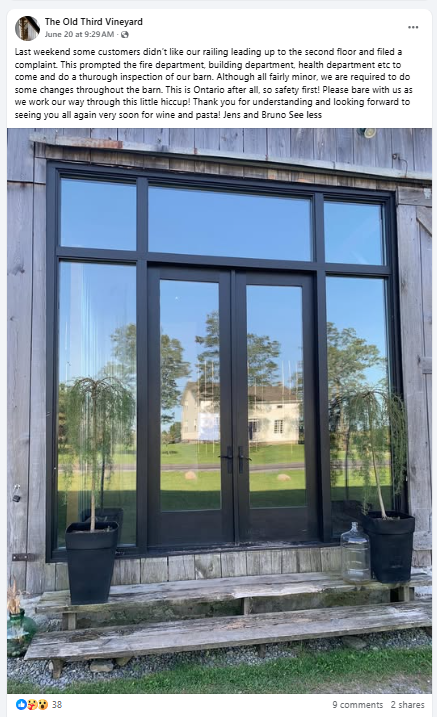
On a warm weekend in Prince Edward County, a local winery found itself at the centre of a conversation that had very little to do with wine and even less to do with railings. The owners posted a message explaining that a customer complaint about a railing had prompted visits from several departments. Inspectors attended the property, deficiencies were identified, and changes would be required. The owners assured customers they would make the necessary adjustments and thanked them for their patience while the work was completed.
On its face, it was an unremarkable story. A complaint had been made, officials investigated, and corrective action followed. Such interactions occur every day in municipalities across Ontario. Yet within hours, the discussion had transformed into something much larger than a question of building standards or public safety.
The comments that followed were revealing. Most people were not debating the merits of the complaint. Few were discussing building codes, inspection protocols, or the technical requirements of a railing. Instead, residents began talking about roads, housing, taxes, water bills, and the broader performance of local government. The post became a lightning rod for frustrations that had been building for years.
What many residents appeared to be asking was a simple question: why does government often seem capable of responding quickly to a complaint, while some of the community’s largest and most persistent challenges continue unresolved year after year?
A Community Looking for Results
The reaction to the winery’s post reflected something deeper than annoyance about a building inspection. It reflected a growing impatience with what many perceive as a mismatch between effort and outcome. Nobody suggested that safety should be ignored. Few argued that standards should not be enforced. Yet many residents appeared to be comparing the speed with which government can respond to a complaint against the pace at which it addresses larger public concerns.
For many people, the contrast feels increasingly difficult to ignore. A complaint can generate inspections and action within days. Meanwhile, broader issues that affect thousands of residents seem to move through years of studies, reports, committee meetings, consultations, and strategic plans with little visible change on the ground.
Whether that comparison is entirely fair is almost beside the point. Public confidence is often shaped less by technical explanations and more by lived experience. Increasingly, the lived experience of many residents is one of rising costs and unresolved challenges.
The Roads Everyone Sees
Roads provide perhaps the clearest example. Municipal infrastructure reports and asset management plans tell one story, but residents experience another every time they leave their driveway. They navigate potholes, frost heaves, deteriorating shoulders, patched pavement, and roads that often appear to receive temporary repairs long before permanent solutions arrive.
Unlike many government programs, roads are impossible to hide. Every resident sees them. Every visitor experiences them. Every damaged tire, bent rim, broken suspension component, and costly repair bill becomes a reminder that infrastructure maintenance has consequences far beyond engineering reports and budget documents.
When people drive over deteriorating roads every day and then watch government respond swiftly to relatively minor compliance matters, a narrative begins to emerge. Fair or unfair, many residents conclude that government appears more effective at enforcing rules than solving problems. That perception may not reflect the complexity of municipal operations, but perceptions often shape public trust more powerfully than facts alone.
Housing Without Homes
Housing presents a similar challenge. For more than a decade, affordable housing has been identified as one of Prince Edward County’s most pressing issues. Numerous reports have been commissioned. Consultants have been retained. Committees have been established. Strategic plans have been developed. Public meetings have consumed hundreds of hours.
Yet many residents continue to ask a straightforward question: where are the homes?
The frustration is not necessarily directed at any single project, councillor, or policy. Rather, it stems from the growing gap between discussion and results. Residents hear about housing constantly. They read reports about housing. They attend meetings about housing. But many struggle to identify tangible outcomes that match the scale of the effort and expenditure.
Governments often measure progress through plans, studies, partnerships, and policy development. Residents tend to measure progress through completed homes and occupied units. When those two perspectives diverge for too long, frustration becomes inevitable.
The Water Bill on the Kitchen Table
Water and wastewater costs have become another source of growing concern. Municipal officials can correctly explain that aging infrastructure requires investment and that decades-old systems must eventually be upgraded or replaced. They can point to environmental regulations, treatment standards, growth pressures, and capital requirements. All of those explanations may be accurate.
Yet most residents do not experience government through technical reports. They experience it through the bills that arrive in their mailbox.
For many households and businesses, those bills have become increasingly expensive. Residents are repeatedly told that major investments are necessary, but many struggle to reconcile rising costs with what they perceive as limited improvements in their daily lives. Whether that perception is entirely justified matters less than the fact that it exists and continues to grow.
When residents feel they are paying more every year while seeing little visible improvement in roads, housing, affordability, or services, their patience begins to wear thin.
The Difference Between Enforcement and Leadership
The challenge facing every municipality is that enforcement is often easier than leadership. Enforcement involves applying existing rules and standards. Leadership involves solving difficult, expensive, and politically complicated problems.
It is easier to identify a code deficiency than to address a housing shortage. It is easier to inspect a railing than to rebuild an aging road network. It is easier to enforce compliance than to restore public confidence. None of this diminishes the importance of regulation. Municipalities have a responsibility to protect public safety, and inspections are an essential part of that responsibility.
However, residents also expect government to demonstrate the same urgency when addressing the larger issues shaping their lives. They expect the same determination that appears during inspections to be visible when confronting infrastructure deficits, housing affordability, water costs, and long-term community sustainability.
The frustration arises not because inspections occur, but because many residents do not see comparable urgency applied to the challenges that affect the entire community.
What the Winery Post Really Revealed
In the end, the winery’s Facebook post was never really about a railing. It became a reflection of something much larger. It exposed a growing conversation about priorities, responsiveness, and public confidence. Residents used a story about a building inspection as an opportunity to express broader concerns about the direction of their municipality and the issues they believe deserve greater attention.
When discussions about roads, housing, water bills, taxes, and affordability emerge from a story about a railing, it suggests that many residents are no longer evaluating government solely on whether rules are enforced. They are evaluating government on whether it is delivering results where those results matter most.
The real issue, therefore, is not compliance. It is confidence. Residents want to know that government is not only capable of enforcing standards but also capable of solving problems. They want to see evidence that the same responsiveness applied to individual complaints is being applied to the broader challenges facing the community.
Because while a railing can be repaired in a matter of days, rebuilding public confidence takes much longer. And confidence, once lost, is far more difficult to restore than any physical structure ever will be.