
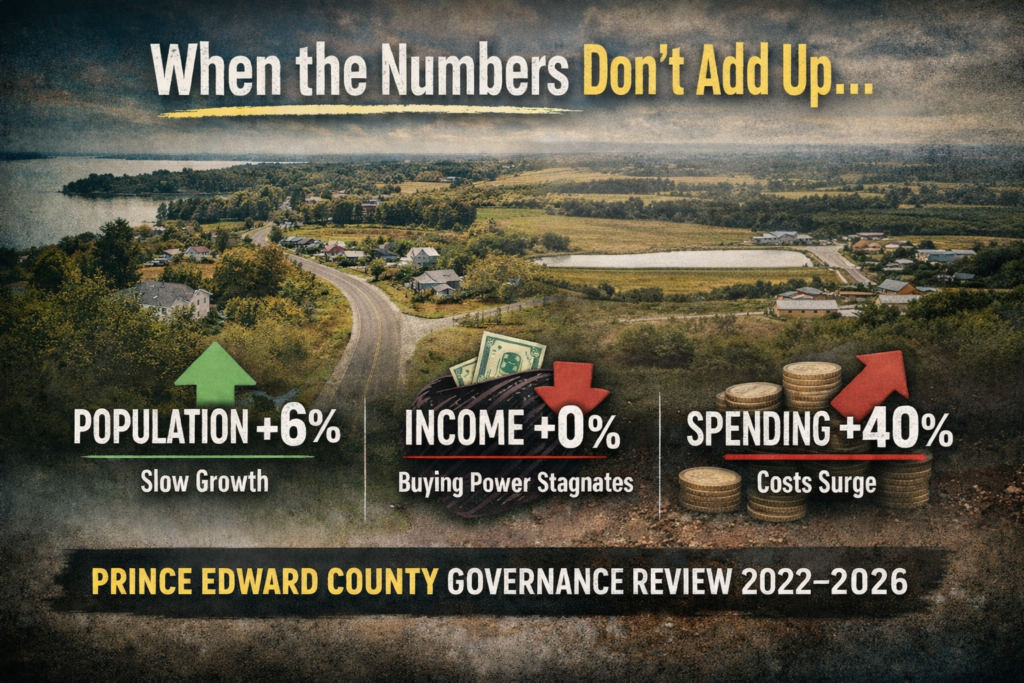
Municipal governance involves both Council and the mayoral office. While ward councillors represent geographic constituencies, the mayoral office carries broader responsibilities including budget leadership, intergovernmental coordination, administrative stability, and communication with residents.
The indicators below are opinion-based governance assessments derived from publicly available records, including budget debates, council minutes, infrastructure advocacy, and recurring themes raised during public meetings and community discussion. This article analyzes publicly available financial data, council records, and observable policy outcomes. Interpretations are offered as commentary on matters of public governance and may reasonably be subject to differing viewpoints. They are intended as commentary on matters of public interest, not as findings of misconduct, bad faith, or legal breach.
Council Governance Snapshot
| Ward | Primary Governance Focus (Observed Themes) |
| 1 – Picton | Urban planning, waterfront initiatives, and debate about balance between amenity investment and rural service priorities |
| 2 – Bloomfield | Generally aligned with staff recommendations, with limited visible evidence of structural cost challenge |
| 3 – Wellington | Consistent fiscal scrutiny and visible concern regarding reserve use and spending trajectory |
| 4 – Ameliasburgh | Persistent rural infrastructure concerns, with limited visible shift in fiscal prioritization |
| 5 – Athol | Strong resident communication and visible explanation of budget trade-offs |
| 6 – Sophiasburgh | Policy-focused engagement and moderate fiscal positioning |
| 7 – Hillier | Active in tourism and governance debates, with mixed fiscal advocacy |
| 8 – North Marysburgh | Ongoing rural road concerns, including CR49, with limited visible structural fiscal shift |
| 9 – South Marysburgh | Visible emphasis on environmental issues alongside ongoing debate about broader infrastructure priorities |
| 10 – Hallowell | Development and planning engagement with moderate fiscal posture |
These indicators reflect observable governance priorities and recurring public discussion themes during the council term. They are not statements of fact about character, intent, or legality.
Governance Assessment: Mayoral Office (2022–2026)
The mayoral office carries distinct responsibilities within Ontario municipal governance, including budget leadership, coordination with senior levels of government, administrative stability, and public communication.
The following assessment reflects observable governance patterns during the current council term.
| Evaluation Category | Observed Themes | Commentary |
| Fiscal Discipline & Budget Leadership | Municipal spending growth exceeded population and income growth | Residents increasingly expect clearer cost controls |
| Reserve & Debt Oversight | Reserve transfers were used to stabilize the 2026 budget | Some public commentary has characterized this as a temporary measure |
| Infrastructure Advocacy | Visible engagement on the County Road 49 file | One of the clearer areas of leadership visibility |
| Transparency & Resident Communication | Budget information is publicly available but often complex | Accessibility remains a challenge |
| Governance Integrity & Process | Commitment to delegate Strong Mayor powers where possible | Reflects collaborative governance approach |
| Alignment with Resident Priorities | Mixed public sentiment on affordability and infrastructure outcomes | Perception gap persists between spending and visible results |
Detailed Mayoral Office Performance
The mayoral office plays a central role in municipal governance under Ontario’s Municipal Act. While Council collectively approves budgets and policies, the mayor typically serves as the political head of the municipality, responsible for providing leadership to Council, coordinating with senior levels of government, supporting administrative stability, and communicating priorities to residents.
The observations below summarize publicly visible governance patterns associated with the mayoral office during the 2022–2026 council term.
Observed Strengths
Governance Process and Strong Mayor Powers Restraint
Prince Edward County was designated under Ontario’s expanded Strong Mayor governance framework effective May 1, 2025.⁶
The Strong Mayor framework grants additional executive powers, including authorities related to budget direction, committee appointments, and advancing matters aligned with provincial priorities.
Public statements indicated that the mayoral office intended to delegate these powers back to Council and the Chief Administrative Officer wherever possible. Council subsequently passed a resolution expressing concern about the governance implications of the provincial framework and the potential concentration of executive authority.
By signaling a willingness to limit the practical use of these powers, the mayoral office appeared to favour maintaining the County’s traditional collaborative council governance model.
Administrative Stability During CAO Transition
During a period of administrative transition in 2025, Prince Edward County appointed an Interim Chief Administrative Officer.
Public communications emphasized continuity of leadership and operational stability during the transition. Maintaining continuity in senior administration is generally considered an important responsibility of the mayoral office, particularly during periods of organizational change.
Infrastructure Advocacy
County Road 49 has remained one of the most frequently cited infrastructure concerns among residents and local businesses.
Public reporting indicates that the mayoral office engaged with federal representatives and encouraged residents to submit feedback and support through the County’s engagement portal regarding potential funding opportunities.
Although major infrastructure funding decisions ultimately depend on provincial and federal programs, municipal advocacy is often viewed as an important step in advancing large-scale projects.
Observed Challenges and Recurring Concerns
Budget Confidence Gap
Despite official communications highlighting capital investment and infrastructure spending, some residents and public commenters continue to question the relationship between rising property taxes and visible service improvements.
The 2026 tax-supported operating budget required a 3.56 percent levy increase, while the County’s capital program reached approximately $22.6 million.³
For many observers, the concern is not the legality of spending decisions, but whether the County’s fiscal strategy clearly prioritizes affordability alongside infrastructure renewal.
Reserve Use During Budget Stabilization
During the final stages of the 2026 budget process, Council used reserve transfers to mitigate the financial impact of rising operating costs, including higher-than-anticipated policing expenses related to Ontario Provincial Police service costs.³
Reserve funds are commonly used by municipalities as a financial management tool. However, when reserve transfers are used to stabilize operating budgets, some residents interpret this approach as a temporary measure rather than a long-term structural solution.
Budget Communication Gap
Prince Edward County publishes detailed budget documents and public engagement materials each year.
However, some residents report that these materials can be difficult to interpret without specialized financial or municipal governance knowledge.
In municipal governance, transparency alone is often not sufficient. Clear explanations of spending priorities, long-term financial strategy, and measurable outcomes can be equally important for maintaining public confidence.
Performance Context
The mid-range governance indicator for the mayoral office reflects two parallel dynamics observed during the 2022–2026 council term.
On one hand, the mayoral office has emphasized governance process, administrative stability, and restraint in the use of expanded executive powers under the Strong Mayor framework.
On the other hand, residents continue to express concern about affordability pressures, infrastructure outcomes, and the long-term trajectory of municipal spending.
These themes are likely to remain central issues as Prince Edward County approaches the October 2026 municipal election.
Legal Note
This article provides commentary on municipal governance and public policy based on publicly available information and observable council decisions. The governance indicators and performance bands are opinion-based assessments derived from public records and recurring discussion themes. They do not allege misconduct, bad faith, or legal breach. Commentary on elected officials and matters of public interest is protected under Canadian law, including principles articulated in the Supreme Court of Canada decision Grant v. Torstar Corp. Additional information.
Sources
¹ Statistics Canada — Census of Population
https://www12.statcan.gc.ca/census-recensement
² Statistics Canada — Canadian Income Survey
https://www150.statcan.gc.ca
³ Prince Edward County Budget Documents
https://www.thecounty.ca/county-government/budget-finance
⁴ Ontario Municipal Financial Information Return Data
https://www.ontario.ca/page/municipal-financial-information
⁵ Municipal Act, 2001
https://www.ontario.ca/laws/statute/01m25
⁶ Ontario Ministry of Municipal Affairs — Strong Mayor Powers
https://www.ontario.ca/page/strong-mayor-powers-and-duties
Prince Edward County Is Choking Innovation — and the Data, the Law, and the Outcomes All Point to the Same Failure
This is no longer anecdotal. According to a recent economic snapshot presented to Council by the County’s own Economic Development Officer, nearly a quarter of the County’s wineries and vineyards are currently for sale. Three of six cideries, two distilleries, and at least nine wineries or vineyards are on the market. Read more.
Audit of the 2022–2026 Council term
As the October 26, 2026 municipal election approaches, the residents of Prince Edward County are conducting a rigorous audit of the 2022–2026 term. This Council has presided over a period of unprecedented fiscal volatility, marked by a $90.9 million budget and a debt trajectory that many fear has reached a point of no return. The following report card evaluates the performance of all ten wards, focusing on cost-of-living increases, infrastructure delivery, and the independence of leadership. Read more.
Food Insecurity: What the Data Actually Shows.
Clearing Up Common Misconceptions. Food insecurity in Canada is often misunderstood. Some assume it affects only the unemployed. Others believe it is limited to major cities or remote northern communities. There is also a perception that food insecurity surged briefly during COVID-19 but has since stabilized. The data tells a different story. Food insecurity now affects working households, families with children, rural communities, and urban centres alike. Read more.
2026 Municipal Elections: Candidate Guide
As Prince Edward County enters a pivotal election year, the need for professional rigour and transparent governance has never been greater. With the 2026 Municipal Election on the horizon, we are committed to empowering candidates who are ready to move beyond ‘politics as usual’ and tackle the County’s $131M debt and infrastructure challenges with a technical, data-driven mindset. Read more.
Big Hat, No Cattle: Why Prince Edward County’s growth story needs a reality check
Prince Edward County is not opposed to growth. The issue now facing Council and residents is narrower, but far more consequential: whether the population growth assumptions used to justify major infrastructure spending are realistic, evidence-based, and appropriate for long-term financial commitments. Read more.
Development, Due Process, and Public Trust: Legal Questions Raised by the Waring’s Creek Challenge
A recent news release from the Waring’s Creek Improvement Association (WCIA) has raised serious concerns about development approvals in Prince Edward County. While the merits of the specific dispute will ultimately be determined through formal processes, the issues raised point to broader legal and governance questions that extend beyond a single project. Read more.
The Transparency Gap in Municipal Procurement
Building on the recent adoption of the 2026 budget, the discussion around Prince Edward County’s (PEC) procurement policies has shifted from simple “line-item” oversight to a deeper demand for transparency. With contracted services now representing 20% of all municipal spending, the policy governing how these vendors are chosen—and why some are chosen without competition—is under a microscope. Read more.
Ontario’s Child Care Crisis: Why Day Care Shortages Are Now a Province-Wide Economic Emergency
A surprising fact about Ontario’s labour shortage: The shortage is not primarily a skills problem. It is a child care problem. Across the province, employers report unfilled positions at the same time that parents who want to work remain sidelined for 12 to 24 months waiting for licensed child care. In effect, Ontario is limiting its own labour supply by failing to provide the infrastructure that makes work possible. Ontario has well over one million children aged 0–5, while licensed child care spaces typically cover only 30–40 percent of potential demand. Continue reading.
Why Property Taxes should be cut by 20% — and Why Residents Would Benefit
When residents hear “a 20% property tax cut,” the first reaction is often concern: Does this mean fewer services? Worse roads? Cuts to things people rely on? In Prince Edward County’s case, the answer is no. A 20% reduction is not about cutting frontline services. It is about correcting a cost structure that has grown far beyond what comparable municipalities require to deliver equal—or better—outcomes. Read more.