
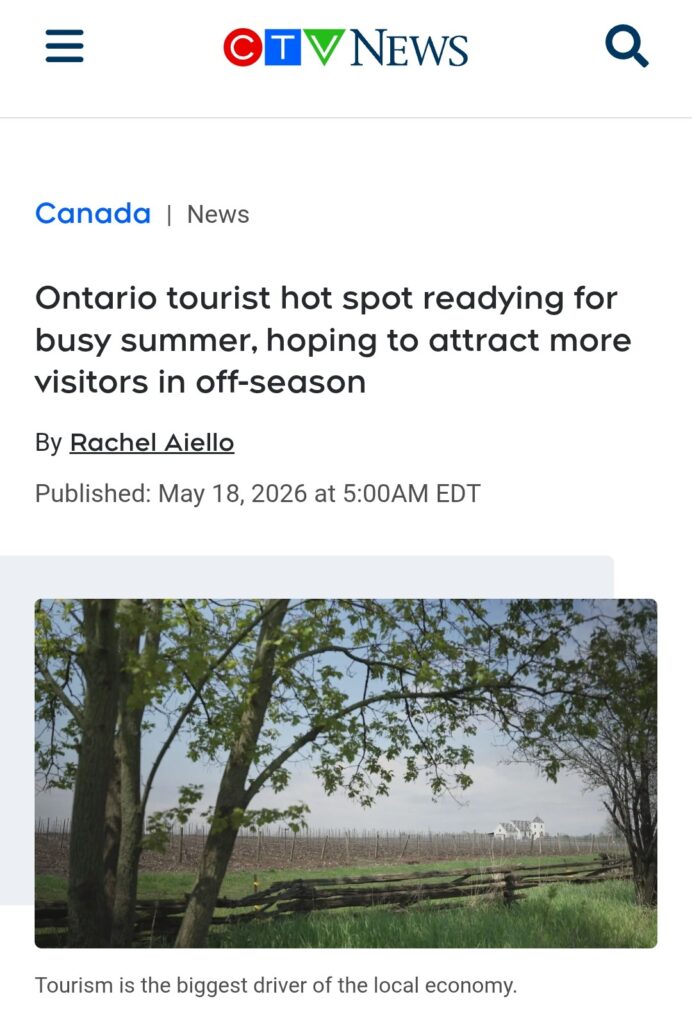
If you caught CTV National News on Victoria Day Monday, you might have walked away believing Prince Edward County is floating on an effortless cloud of economic prosperity.
The segment, titled “Ontario tourist hot spot readying for busy summer, hoping to attract more visitors in off-season,” played out less like an objective, deeply researched news report and more like a pre-packaged corporate press release. Broadcast to hundreds of thousands of viewers across Canada, the piece painted a picture-perfect portrait of a booming summer season and a seamless transition into a “sustainable,” four-season paradise.
But for many who actually live, work, and raise families on this island, the coverage felt overly optimistic—a reflection of uncritical broadcast journalism.
By heavily relying on a small circle of municipal figures and tourism marketing representatives, the segment allowed a curated promotional narrative to steer the coverage completely unchecked. In doing so, it overlooked critical economic datasets and the lived experiences of everyday County residents.
Let’s unpack the public data, challenge the PR framing, and look at the complex economic realities left out of the broadcast.
Fact-Checking the “Booming” Data: The Story Behind the Numbers
The broadcast hinges prominently on quotes from the Executive Director of Visit the County (the region’s Destination Marketing Organization), who noted that summer bookings for July and August are averaging “10 to 20 per cent higher than they were in 2025.”
On the surface, the numbers sound promising. Local data confirms that Municipal Accommodation Tax (MAT) revenues from hotels and Short-Term Accommodations (STAs) saw significant upward movement over the past year. However, a critical piece of contextual data was absent from the reporter’s analysis: broader regional tourism metrics indicate that on an annualized basis, average room occupancy across the region often leaves a significant portion of available inventory unbooked outside peak windows.
While high-end, newly opened properties enjoy strong early-season marketing momentum and high summer occupancy projections, their specific performance is not a uniform indicator for the hundreds of smaller hospitality operators across the County. Furthermore, higher bookings do not automatically translate into healthy net margins. Local small business owners continue to navigate skyrocketing supply chain costs, steep commercial property assessments, and a consumer base dealing with persistent inflationary pressures.
Presenting a select handful of premium hospitality brands as a proxy for the comprehensive economic health of the entire County is analytical oversimplification.
The Industrial Exodus & The Changing Middle Class
The most notable gap in the CTV report was its omission of perspective on the year-round, non-tourism economy. A broader look beyond the tourism sector reveals a deeply strained local economic landscape.
While hospitality sectors capitalize on the compressed summer rush, the industrial and agricultural backbones of the community have faced systemic contraction. The closure of the Highline Mushrooms facility in Wellington removed nearly 300 stable, year-round positions from the local workforce. Highline served as a vital economic anchor, providing dependable year-round employment, circulating local payroll dollars, and contributing to the municipal industrial tax base.
The loss of this facility aligns with a broader trend of industrial shifts away from rural communities. As permanent manufacturing and agricultural processing jobs disappear, they are increasingly replaced by highly seasonal, part-time service roles—employment structures that present steep challenges for families attempting to maintain a middle-class standard of living year-round.
The Regional Manufacturing Divide
The economic trajectory of Prince Edward County stands in sharp contrast to our immediate geographic neighbours. While the County has concentrated its economic development strategies heavily on boutique tourism and hospitality, neighboring municipalities have aggressively diversified into more stable sectors:
| Region | Economic Strategy | Year-Round Employment Stability |
|---|---|---|
| Belleville & Quinte West | Strong, diversified manufacturing sector and industrial park expansions. | High (Stable industrial, technical, and unionized roles). |
| Kingston & Trenton | Heavy focus on logistics, manufacturing, and public sector employment. | High (Resilient to seasonal tourism cycles). |
| Prince Edward County | Hyper-focus on tourism, wineries, and short-term accommodations. | Low (Highly volatile, seasonal, service-reliant economy). |
While Belleville, Kingston, Quinte West, and Trenton have successfully attracted and retained year-round manufacturing infrastructure, Prince Edward County’s heavy pivot toward a visitor-centric economy has left its local population exposed to seasonal volatility.
The Social Cost: Youth Employment and Systemic Pressures
The long-term consequence of a diminishing year-round industrial base is a brewing socio-economic challenge that a brief, glossy television segment is ill-equipped to capture.
With fewer entry-level agricultural, technical, or industrial paths available locally, youth employment opportunities have become increasingly constrained outside of the summer months. Local youth are frequently left with a narrow choice: navigate temporary, service-reliant summer shifts, or exit the community entirely to build long-term, stable careers elsewhere.
This lack of diversified economic opportunity correlates closely with entrenched regional social metrics. Public health data consistently tracks the Hastings and Prince Edward region with teenage pregnancy rates that sit visibly above the provincial average. When a community lacks a clear, accessible, year-round economic ladder for its younger demographic, the broader social fabric inevitably experiences strain.
The “Four-Season” Fantasy vs. Infrastructure Realities
The latter half of CTV’s piece read much like a promotional brochure for the municipality’s push to transform the County into a four-season destination. The Mayor highlighted efforts to draw events into the “shoulder seasons,” while winery representatives discussed winterizing facilities to secure a steady stream of off-season visitors.
While an appealing goal for a broadcast soundbite, it glosses over severe operational realities:
- The Core Seasonal Drift: As the winery representative interview acknowledged, roughly 50 percent of annual sales remain concentrated between June and September, requiring staffing levels to fluctuate drastically from 6 year-round employees to 25 during the summer.
- The Tourism Deficit: Off-season tasting room upgrades are a prudent individual business pivot, but they cannot structurally replace the immense economic velocity generated by tens of thousands of summer visitors traveling to Sandbanks Provincial Park.
- The Housing and Staffing Crunch: The Mayor characterized housing affordability as a generic problem felt “everywhere.” However, in resort-style economies, housing pressures represent an acute crisis. Local businesses regularly face operational bottlenecks because seasonal and service workers find it mathematically impossible to secure affordable local housing.
- The Talent Pipeline Block: The local hospitality labor market recently suffered a structural setback following the suspension of key culinary and hospitality programming at Loyalist College. Relying on a simplified narrative about returning student labor ignores the reality that local venues face a distinct shortage of skilled, professional kitchen and management staff.
The Great MAT Tax Disconnect
The broadcast celebrated rising tourism revenues but omitted critical context regarding municipal cost distributions. Local residents monitoring council chambers know that while a significant portion of the revenue collected via the Municipal Accommodation Tax (MAT) is allocated by law to tourism marketing entities like Visit the County, the municipality’s share is increasingly diverted to basic maintenance. In recent budget deliberations, Council directed over $1.2 million of tourism-associated tax revenues simply to fund fundamental road repairs.
A strong argument exists that the entirety of municipal MAT proceeds should be aggressively funneled into infrastructure. The heavy influx of seasonal visitor traffic—including commercial logistics, heavy construction vehicles, and high volumes of RVs—inflicts severe structural degradation on already fragile rural roads. County residents are left to navigate these deteriorating roads and potholes long after peak season ends, all while bearing the burden of rising municipal tax rates that challenge local affordability.
The Verdict on the Coverage
It is entirely expected for destination marketing organizations to put a favorable perspective on regional data—that is their organizational mandate. However, the public should expect a higher standard of inquiry from national journalists and elected public officials.
By failing to look beneath corporate metrics, probe structural economic data, or balance the narrative with the perspectives of residents who experience the day-to-day realities of this hyper-tourism pivot, the broadcast provided an incomplete view to its national audience.
Prince Edward County is a beautiful and resilient community, but overlooking its deep-seated structural challenges and localized economic downturns will not solve them. It is time for national media outlets to step away from curated PR packets, look past the playground perspective of urban weekenders, and accurately report on the complex, hardworking, and often challenging lives of the people who call this County home year-round.
A formal perspective or commentary is welcomed from Mirko Bibic (President and Chief Executive Officer of BCE) and the Board of Bell Media Inc.
Featured
When the Anchor Employer Leaves: Why Rural Economies Feel It First—and What Happens When Policy Falls Behind
Across Ontario, a pattern keeps resurfacing: when a major employer scales down or leaves, the effects ripple through the entire community. In rural municipalities, where there are fewer large employers to begin with, that impact is amplified. This isn’t just anecdotal—it’s reflected in the structure of employment itself. Read more.
Nothing Is Free Anymore… Except “Feel Good” Government Advertising
How does this ad help Ontarians? What does “fighting for every auto job” mean? How is spending millions of dollars on such advertising productive use of your hard earned tax dollars? Look in your community newspapers and you will see these full page ads. Several of them. Read more.
How a different kind of culture is reshaping Counties
There was a time—not that long ago—when counties didn’t need to announce themselves. They didn’t need branding. They didn’t need amplification. They didn’t need to be seen. People came here, or stayed here, for something quieter. Something more personal. Read more.
The $12 Million Question: What Prince Edward County’s Sunshine List Really Shows
Prince Edward County’s 2025 Sunshine List isn’t just a headline—it’s a signal. The County disclosed 92 municipal employees earning over $100,000, with total compensation exceeding $12 million annually. That’s a sharp increase from 64 employees in 2023, a 43% jump in just two years. Even more striking: the County employs roughly 220 staff, meaning nearly half of all employees now earn above the Sunshine List threshold. Read more.
The Quiet Shift No One Is Talking About: Are Counties Becoming Places You Can’t Afford to Live — But Also Can’t Afford to Leave?
There’s a strange contradiction emerging across Ontario’s counties. People are moving in — but long-time residents are feeling pushed out. Businesses are busy — but many are barely surviving. Homes are worth more — but fewer people can actually afford to live in them. Something has shifted. And while we talk about it in pieces — housing, taxes, groceries, healthcare — we rarely step back and ask the bigger question: Are counties becoming economically unlivable for the people who built them? Read more.