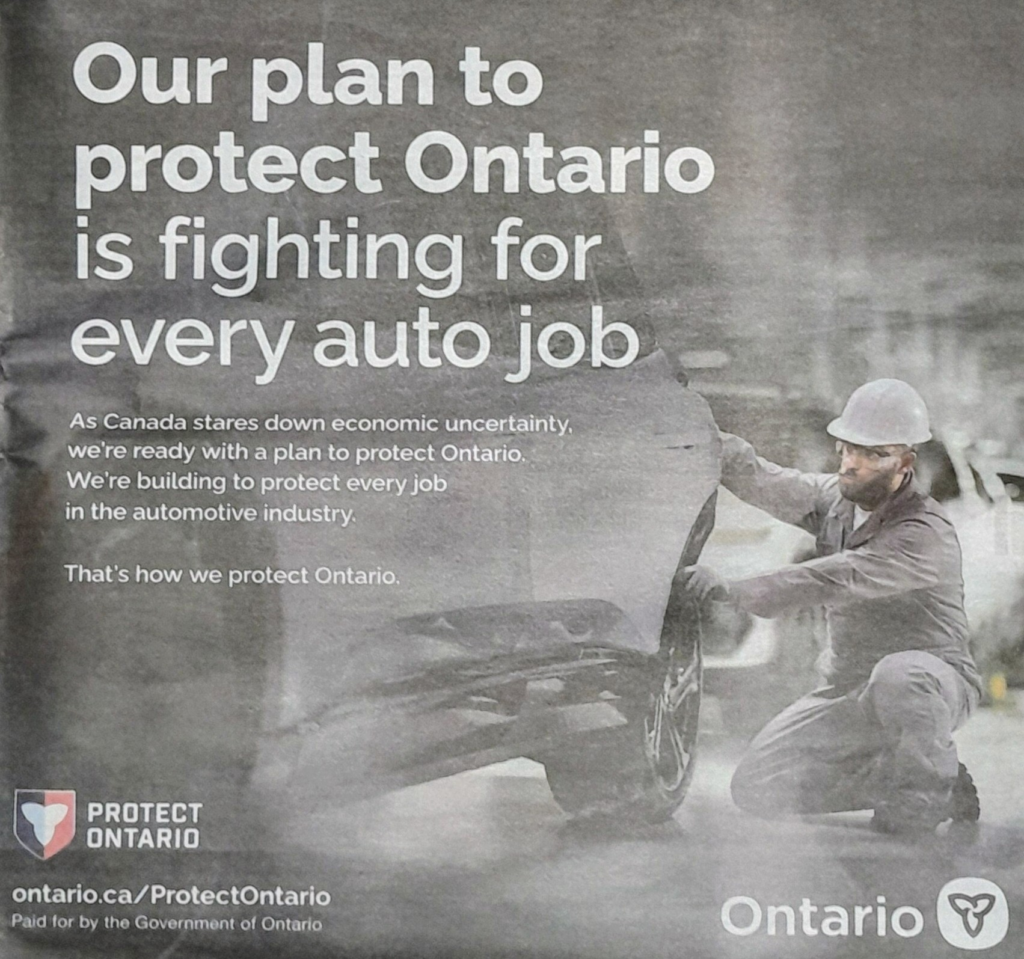
How does this ad help Ontarians? What does “fighting for every auto job” mean? How is spending millions of dollars on such advertising productive use of your hard earned tax dollars? Look in your community newspapers and you will see these full page ads. Several of them.
Ontario’s advertising spend is much larger than most readers likely realize. The Auditor General reported that Ontario spent $103.5 million on advertising in fiscal 2023/24, and then a record $111.9 million in 2024/25. In 2023/24, the top 10 campaigns accounted for $95.2 million, or 92% of total spending, and the two biggest campaigns alone accounted for 65% of total advertising spend. In 2024/25, 38% of all Ontario advertising spending was directed to just one campaign, “Protect Ontario.”
That matters because residents are simultaneously being told that user fees are necessary for access to places that support physical and mental health.
Ask your MP and MPP why->
The contradiction
On one hand:
- Residents are paying more for basic access to nature
- Fees are justified as “cost recovery”
- Access is restricted to manage demand
On the other:
- Governments fund marketing campaigns
- Tourism promotion continues
- Administrative costs and salaries rise
- Non-core spending continues
Ontario Parks’ 2026 day-use permit schedule lists annual vehicle permits at $111.87 total and summer permits at $84.75 total, while daily vehicle permits vary by park and season. Ontario Parks also says day-use bookings are required in advance at many parks to guarantee access because capacity is limited.
For example, Quinte Conservation’s 2026 fee schedule puts the annual access pass at $65, daily access at Little Bluff at $17, and daily access at all conservation areas except Little Bluff at $8 for a regular passenger vehicle. Quinte Conservation also says its gates and parking system are intended to manage visitor numbers and issues such as vandalism, illegal dumping, and loitering, and that its annual pass is valid across its conservation areas.
That creates a sharp public-policy contrast: Ontario spent $111.9 million on advertising last year, while a family wanting regular access to parks and conservation areas is increasingly asked to pay by the visit, buy passes, or pre-book access. Even if those systems are defensible administratively, the priorities are worth questioning. A province that can spend nine figures on messaging clearly has fiscal room to make different choices about basic public access.
A simple comparison chart helps make the point.
Comparison: public messaging vs access fees
| Item | Amount |
|---|---|
| Ontario government advertising spend, 2023/24 | $103.5 million |
| Ontario government advertising spend, 2024/25 | $111.9 million |
| “Protect Ontario” share of 2024/25 ad spend | 38% |
| Ontario Parks annual vehicle permit, 2026 | $111.87 |
| Ontario Parks summer vehicle permit, 2026 | $84.75 |
| Quinte Conservation annual pass, 2026 | $65 |
| Quinte Conservation daily pass – Little Bluff | $17 |
| Quinte Conservation daily pass – other areas | $8 |
Sources: Ontario Auditor General, Ontario Parks, Quinte Conservation.
The broader argument is not that maintenance has no cost, or that conservation lands should be unmanaged. It is that access to nature is not a luxury add-on. There is strong evidence that access to green space supports physical activity, mental well-being, and healthier communities. When governments choose to monetize routine access while continuing to spend heavily on public messaging and promotion, residents are entitled to ask whether the balance has shifted too far toward bureaucracy, branding, and cost recovery. That is especially true in places like Prince Edward County, where tourism pressure has already changed how locals experience nearby beaches, shoreline, and trails.
Question: Should locals get free or discounted access to nearby parks and conservation areas?
Disclaimer
This article is based on publicly available information and general policy observations. Fee ranges are approximate and vary by jurisdiction. This is commentary on matters of public interest.
Featured
From Crude to Crust: The Invisible War Tax on Your Grocery Bill
The average Canadian grocery trip is starting to feel like a high-stakes negotiation. Just as food inflation appeared to be cooling—dropping to 5.4% in February 2026—the outbreak of conflict in Iran on February 28 has sent a shockwave through the global economy that is landing directly in our shopping carts. While the fighting is thousands of kilometers away, the economic tether between Middle Eastern stability and Canadian food prices is shorter than most realize. Read more.
$25 billion for Ukraine while you dodge potholes on County roads
Drive down County Road 49 after a rough winter and you’ll feel it immediately—the jolts, the patched asphalt, the sense that basic infrastructure is always one season behind. Now contrast that with the scale of federal spending headlines: tens of billions committed abroad, tens of billions more for defence, and hundreds of billions in total annual spending. It’s not that any one of those expenditures is inherently wrong. It’s that for many Canadians, the connection between what they pay in taxes and what they see on the ground is becoming harder to recognize. Read more.
Leave a Reply