
Local issues. Ontario-wide lessons. Follow County First on Facebook.
Word on the Street: Snippets | Bruce | Dufferin | Elgin | Frontenac | Grey | Haliburton | Hastings | Huron | Kawartha Lakes | Lanark | Leeds & Grenville | Lennox & Addington | Middlesex | Norfolk | Northumberland | Oxford | Perth | Peterborough | Prince Edward | Renfrew | Simcoe | Wellington

Word on the Street
What residents ACROSS COUNTIES Are Really Talking About
A comprehensive review of policy and developments that impact our communities.
Three Rental Properties Generated 29% of the Complaints. What Ontario’s By-law Enforcement Numbers Reveal
Prince Edward County lists penalties of up to $20,000 for operating an unlicensed short-term accommodation. Tiny Township found that a handful of properties accounted for a remarkable share of complaints. And in Centre Wellington, a proposed $825,000 enforcement budget tells a very different story once revenues and reserve transfers are considered. County First examines what municipalities spend enforcing their rules — and what taxpayers can actually measure. Continue reading.
The Cost of Living in Your Own Community
A Special Investigation into Taxes, User Fees and Municipal Affordability especially in rural Ontario. For decades, municipal governments were funded primarily through property taxes, with user fees reserved for specialized services or optional activities. Today, many residents feel that balance has shifted. Property taxes continue to rise, yet so do parking fees, permits, licences and a growing list of charges attached to everyday activities. Read more.
The Rural Impaired-Driving Problem. Impaired-driving rates are nearly 3× higher in rural Canada than in urban Canada. Why?
What Prince Edward County’s unfinished search for a dependable ride home can teach every rural community. A resident of Prince Edward County recently posed a question that could have come from almost any tourism county, farming district or small municipality in Canada: if the Ontario Provincial Police are intensifying enforcement against impaired driving, how can the community bring Uber, Lyft or another dependable ride service into the region? Read more.
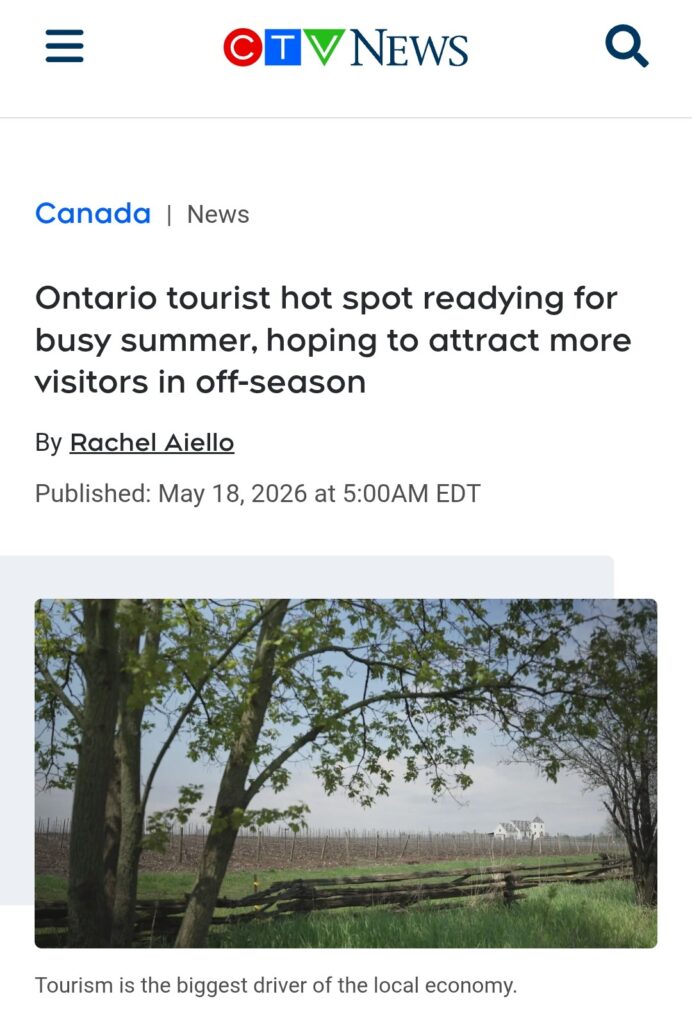
CTV’s ‘Rosy’ View of County Tourism: Lazy Journalism Blindsides PEC Realities
If you caught CTV National News on Victoria Day Monday, you might have walked away believing Prince Edward County is floating on an effortless cloud of economic prosperity. The segment, titled “Ontario tourist hot spot readying for busy summer, hoping to attract more visitors in off-season,” played out less like an objective news report and more like a slick, pre-packaged corporate press release.
Broadcast to hundreds of thousands of viewers across Canada, the piece painted a picture-perfect portrait of a booming 2026 summer season and a seamless transition into a “sustainable,” four-season paradise. Read more.

Nothing Is Free Anymore… Except “Feel Good” Government Advertising
How does this ad help Ontarians? What does “fighting for every auto job” mean? How is spending millions of dollars productive use of your hard earned tax dollars? Look in your community newspapers and you will see these full page ads.
Ontario’s advertising spend is much larger than most readers likely realize.
That matters because residents are simultaneously being told that user fees are necessary for access to places that support physical and mental health. Read more.
The Quiet Crisis in Municipal Democracy
Why voter apathy may be costing communities more than they realize. The most important decisions affecting daily life are often made by the level of government people pay the least attention to. And yet across Ontario—and much of Canada—municipal elections continue to suffer from chronically weak voter participation. In many communities, fewer than half of eligible residents vote in local elections. Some municipalities struggle to reach even 35–40%. Read more.
Should Councillors Be Paid $100,000?
What compensation really says about who gets to run—and who doesn’t. Across municipalities, one quiet factor shapes local democracy more than most policy debates: Who can afford to run for council? It’s not always about ideas or commitment. Often, it comes down to whether the role is financially viable. Read more.
Ontario taxpayers funded a government jet. Do you support this?
The aircraft itself cost about $28.9 million. But the total program cost is higher when you include: modifications and retrofitting, security upgrades, training and setup in addition to ongoing operating costs (fuel, crew, maintenance).
https://www.cbc.ca/news/canada/toronto/doug-ford-private-jet-9.7167824
Estimates for the full cost over time can reach tens of millions more beyond the purchase price as much as $50 million. Premier Doug Ford says it’s about efficiency for trade missions and emergency use.
Arguments FOR:
- Faster, more flexible travel for economic deals
- Better access to remote areas
- Can be used in emergencies
- Could reduce reliance on charters over time
Arguments AGAINST:
- Significant total cost beyond the $28.9M purchase
- Optics during a cost-of-living crisis
- Questions about frequency of use
- Commercial options already available
So where do you land?
- Support it
- Oppose it
- Depends on how it’s used
-> https://www.facebook.com/countyfirstnow
When the Anchor Leaves: Why Rural Economies Feel It First—and What Happens When Policy Falls Behind
Across Ontario, a pattern keeps resurfacing: when a major employer scales down or leaves, the effects ripple through the entire community. In rural municipalities, where there are fewer large employers to begin with, that impact is amplified. This isn’t just anecdotal—it’s reflected in the structure of employment itself. Read more.
Who Owns Access to Nature Anymore?
Across Ontario- and in small counties everywhere- something is changing. Access to nature is no longer as simple as it used to be. There was a time when you could head out to a local trail, shoreline, or conservation area without much thought. Read more.
The Quiet Shift No One Is Talking About: Are Counties Becoming Places You Can’t Afford to Live — But Also Can’t Afford to Leave?
There’s a strange contradiction emerging across Ontario’s counties. People are moving in — but long-time residents are feeling pushed out.
Businesses are busy — but many are barely surviving. Homes are worth more — but fewer people can actually afford to live in them. Something has shifted. And while we talk about it in pieces — housing, taxes, groceries, healthcare — we rarely step back and ask the bigger question: Are counties becoming economically unlivable for the people who built them? Read more.
Lawns in Ontario: The Hidden Water Cost and the Cheaper, Better Alternatives
In Ontario counties, lawns feel harmless. They’re green, they’re familiar, and they signal “a well-kept property.” But if you follow the water numbers, a different story emerges: in summer, lawns become one of the biggest drivers of municipal water stress, and they deliver surprisingly little ecological value in return. This isn’t a theory. Ontario municipalities have built watering bylaws precisely because outdoor demand spikes so sharply, so predictably, and so expensively. Read more.
Food Insecurity: What the Data Actually Shows.
Clearing Up Common Misconceptions. Food insecurity in Canada is often misunderstood. Some assume it affects only the unemployed. Others believe it is limited to major cities or remote northern communities. There is also a perception that food insecurity surged briefly during COVID-19 but has since stabilized. The data tells a different story. Food insecurity now affects working households, families with children, rural communities, and urban centres alike. Read more.
The Cost of Living Crisis Beyond Housing: Why Essentials Are Breaking Family Budgets
Housing still dominates headlines, but across Ontario’s counties, residents are increasingly clear: the real affordability crisis is about essentials. Food, fuel, utilities, and property taxes are consuming more household income than ever before.
According to Statistics Canada, food prices rose roughly 20% between 2020 and 2024, with cumulative increases closer to 35–40% over the past decade. These increases are permanent; prices did not fall back when inflation slowed. Rural and county households spend a larger share of income on food, meaning the impact is magnified outside cities.
Fuel costs compound the problem. County residents drive longer distances for work, healthcare, and daily needs, with few alternatives to personal vehicles. Even when gas prices fluctuate, the baseline cost remains far higher than pre-pandemic levels. Utilities add another layer. Electricity, heating, water, and wastewater costs have risen steadily as infrastructure ages. Smaller systems lack economies of scale, pushing per-household costs higher than in urban centres.
This explains the tone on social media: exhaustion rather than outrage. Families say they have already cut discretionary spending. What remains are fixed costs they cannot escape. Affordability in counties is no longer about lifestyle choices. It is about the basic cost of living—and that is why this issue now dominates local conversation.
Property Taxes and Municipal Spending: Why Trust Is Wearing Thin
Property tax discussions have become some of the most heated conversations in county Facebook groups—and for good reason. Across Ontario, county property taxes have risen roughly 30–40% cumulatively over the past decade, broadly in line with or exceeding general inflation. These increases landed during the same period households absorbed sharp rises in food, fuel, and utility costs. Residents are not only upset about the increases themselves. They are frustrated by how decisions are explained. Budget documents often emphasize inevitability—downloading, infrastructure, staffing—while rarely acknowledging household affordability.
Sunshine List disclosures amplify scrutiny. While the $100,000 threshold is outdated, growing numbers of six-figure municipal earners raise questions for residents whose own incomes have not kept pace with inflation. The perception—fair or not—is that municipal institutions are protected while households absorb the shock. When councils default to tax increases without visible cost containment, trust erodes. This is why tax debates have become proxies for deeper concerns about accountability, transparency, and whether local governments understand lived reality.
Homelessness Has Reached Small Towns — And It’s Growing Fast
Homelessness is no longer an urban-only issue.
Ontario now has over 85,000 people experiencing homelessness, up roughly 50% since 2021. Rural homelessness is estimated to be up 30%, and Northern Ontario saw a 37% increase in a single year. These figures come from provincial service managers and housing agencies. Half of people experiencing homelessness have been without stable housing for six months or longer. About 25% are children or youth. Seniors are increasingly visible, priced out by rising rents and fixed incomes.
Small towns were never designed for this scale of need. They lack shelters, outreach services, and affordable housing stock. When someone loses housing, there is often nowhere to go. Social media reflects shock more than anger. Residents ask: How did this happen here? The answer lies in housing supply shortages, rising living costs, and income supports that no longer match market rents.
Homelessness is now a county issue—and one that will worsen without structural action.
Healthcare Deserts: Why Counties Fear Losing Access to Care
Healthcare access is one of the most emotionally charged topics across counties. Emergency department closures, reduced hours, physician shortages, and long ambulance response times are increasingly common. Rural and northern residents feel especially vulnerable.
According to Ontario health system reporting, many communities struggle to recruit doctors, nurses, and paramedics. Staffing shortages mean services exist on paper but not in practice. Social media posts reflect fear rather than politics. People worry about heart attacks, accidents, and whether help will arrive in time. Healthcare deserts are emerging quietly. Services are not formally removed; they simply become unreliable. This erosion of access undermines confidence in the system and reinforces the sense that county communities are being deprioritized.
School Transportation: When Kids Become the Flashpoint
School transportation remains a surprisingly persistent topic. Parents report route disruptions, driver shortages, and confusion over contracts. Changes are often blamed on “big companies” replacing local operators, though decisions are typically made by transportation consortia under provincial procurement rules.
What drives engagement is not ideology—it’s children. Safety, reliability, and local jobs all intersect here. The frustration reflects a broader trust issue: parents feel decisions affecting kids happen far from their communities, with little transparency. School buses have become a symbol of how complex systems can feel unaccountable at the local level.
Restaurant Closures and the Hollowing Out of Main Street
Restaurant closures are rising sharply across counties. Industry data from Restaurants Canada suggests thousands of restaurants have closed, with 41% operating at a loss or just breaking even.
The reason is simple: food, labour, rent, insurance, and utilities rose faster than consumers’ ability to pay. Customers are not choosing to eat out less—they are being forced to. Even busy restaurants struggle if they do not own their buildings. Margins are gone. Communities feel these losses deeply. Restaurants anchor main streets, employ young people, and create social life. Their disappearance is an economic warning signal.
Climate Policy Meets Affordability: Why Counties Feel the Cost First
Environmental policy has become an affordability issue. Carbon pricing, clean fuel regulations, and electricity system costs add to fuel, food, and utility prices. According to the Parliamentary Budget Officer, rural households face net costs two to three times higher than urban households due to higher fuel use.
Social media sentiment is increasingly skeptical. The concern is not climate action itself, but who pays and who benefits. Counties feel these costs first because alternatives are limited. This fuels distrust and resistance.
Development and “Community Character”: How Fear Shapes Housing Debates
Development debates remain polarized. Subdivision proposals, zoning changes, and short-term rentals trigger fear-based narratives about losing community character. Social media amplifies worst-case scenarios.
Data from Canada Mortgage and Housing Corporation shows communities that resist housing supply often see faster price growth, not preservation. Fear-driven opposition can unintentionally worsen affordability—the very outcome residents want to avoid.
When Kids Pay the Price: Affordability and Shrinking Childhoods
Families increasingly say their children are paying for the cost-of-living crisis. Statistics Canada household spending data shows recreation, sports, childcare, and enrichment activities are among the first expenses cut when budgets tighten.
That means fewer kids in hockey, soccer, swimming, music, and after-school programs. These are not luxuries; they support physical health, learning, and social development. Local policy choices—taxes, fees, utilities—directly affect what families can afford for their children.
Why Trust in Local Institutions Is Eroding
Underlying every topic is declining trust. Closed meetings, consultant-driven decisions, and technical language leave residents feeling excluded. People do not necessarily think officials are corrupt—but they do think decisions are disconnected from lived reality.
When trust erodes, misinformation fills the gap. Rebuilding trust requires transparency, humility, and explicit acknowledgment of household affordability pressures.
Why Food Prices Rise Faster in Smaller Counties Than Big Cities
Food inflation has affected all Canadians, but residents of smaller counties often experience higher grocery prices and fewer price drops than those in large cities. Statistics Canada reports that national food prices rose by roughly 20 percent between 2020 and 2024. However, regional impacts vary significantly. One major factor is market structure. Smaller counties typically have fewer grocery stores and limited competition. While urban centres often have multiple chains, discount banners, and independents competing within a few kilometres, many counties are served by one or two major retailers. The Competition Bureau has repeatedly noted that reduced competition limits price pressure. Transportation costs also play a role. According to Statistics Canada logistics data, rural and low-density regions face higher per-unit delivery costs because trucks travel longer distances to serve fewer stores. These costs are passed on to consumers, especially when fuel prices rise.
Household spending data further highlights the disparity. The Survey of Household Spending shows that rural households spend a higher proportion of income on food than urban households. In counties where median incomes are below provincial averages, even modest price increases have outsized effects on affordability. Product mix matters as well. Smaller stores often carry fewer private-label and discount options, which tend to be cheaper. During supply disruptions, these stores may also have less access to promotional pricing. Together, these structural factors explain why food inflation feels more persistent in counties, even when national indicators suggest easing pressure.
Grocery Store Concentration and What It Means for Counties
Canada’s grocery sector is highly concentrated. According to the Competition Bureau, five companies—Loblaw, Sobeys, Metro, Walmart, and Costco—control more than 75 percent of national grocery sales. In many counties, concentration is even higher. Smaller communities may have only one major grocery store within a reasonable driving distance. This limits consumer choice and reduces competitive pressure on pricing. The Competition Bureau has warned that high concentration can lead to higher prices and reduced innovation.
Counties also face barriers to new entrants. Zoning constraints, infrastructure costs, and population thresholds make it difficult for independent grocers or discount chains to establish operations. As a result, national pricing strategies dominate local markets, even when local economic conditions differ. Data from Statistics Canada shows that grocery prices vary more widely across regions than many other consumer goods, reflecting local market power rather than national supply conditions. For county residents, this means fewer alternatives when prices rise. Travel costs to shop elsewhere further reduce effective choice. Over time, concentration can erode affordability and resilience in local food systems.
Why Counties Feel Inflation Longer Than Cities
Headline inflation figures often suggest that price pressures are easing. Yet many county residents report that everyday costs remain high. Statistics Canada data explains why. Price declines often occur first in discretionary categories such as electronics, apparel, and travel—items more commonly consumed in urban markets. Essential goods like food, fuel, and utilities, which make up a larger share of rural household spending, tend to remain elevated longer. Labour Force Survey data shows that average wages in rural Ontario lag major metropolitan areas. When prices rise faster than wages, the real impact persists even as inflation slows.
Counties also face higher exposure to fuel and transportation costs. Longer commutes and service distances mean energy price increases affect households more directly. This mismatch between national inflation metrics and local experience explains why counties often feel “left behind” during economic recovery periods.
Housing Costs Are Rising in Counties for Different Reasons Than in Cities
Housing affordability challenges are no longer limited to large cities. According to Canada Mortgage and Housing Corporation (CMHC), average rents and resale home prices increased sharply in many Ontario counties between 2020 and 2024, in some cases matching or exceeding percentage growth in major urban centres. The drivers, however, differ from cities. In counties, price pressure is often linked to population inflows rather than employment growth. Statistics Canada migration data shows that many rural and semi-rural counties experienced net in-migration during and after the pandemic, as remote work expanded and households sought more space. This demand shock hit housing markets with limited supply capacity.
Counties typically have slower housing starts. CMHC housing starts data shows that many counties produce only a few dozen new units annually. Planning timelines, infrastructure constraints, and servicing costs limit rapid expansion. Unlike cities, counties often lack centralized water, sewer, and transit infrastructure to support higher-density development. Short-term rentals further complicate supply. In tourism-oriented counties, housing units are frequently removed from the long-term rental pool, tightening vacancy rates. CMHC reports that vacancy rates below 3 percent are now common in many smaller communities. At the same time, incomes have not risen proportionally. Statistics Canada reports that median household incomes in many counties remain below provincial averages. The result is affordability stress driven by demand growth, constrained supply, and slower wage growth—factors that make county housing challenges structurally different and harder to address than urban affordability issues.
Property Taxes: Why Counties Keep Raising Rates
Property taxes are the primary revenue source for county governments, and data from Ontario’s Municipal Financial Information Returns shows why rate increases have become routine. Counties have few alternatives to property taxation, lacking access to income or sales taxes and relying heavily on a fixed assessment base. Cost pressures have increased steadily. Construction price indices published by Statistics Canada show that material and labour costs for municipal infrastructure rose well above general inflation between 2020 and 2024. Roads, bridges, and facilities now cost significantly more to maintain and replace.
Counties also face downloaded responsibilities. The Association of Municipalities of Ontario (AMO) has repeatedly noted that provincial policy changes in areas such as housing, emergency services, and social supports often increase municipal costs without equivalent funding increases. Population growth does not automatically ease pressure. In counties, new development often requires upfront infrastructure investment that exceeds initial tax revenue. This can raise costs for existing taxpayers in the short to medium term. As a result, property tax increases are often structural rather than discretionary. Even fiscally conservative councils face rising baseline costs that must be funded annually, leaving limited flexibility for relief.
Infrastructure Deficits in County Governments
Ontario municipalities face a significant infrastructure funding gap, and counties are among the most affected. The Financial Accountability Office of Ontario estimates that municipalities collectively face an annual infrastructure shortfall of several billion dollars. Counties manage extensive networks of roads, bridges, water systems, and public facilities over large geographic areas with relatively small tax bases. Many assets were built decades ago and are now beyond their original design life.
Deferred maintenance compounds the problem. Engineering studies consistently show that postponing repairs increases long-term costs and service risks. Yet counties often lack the borrowing capacity or grant funding to address all needs simultaneously. Provincial and federal infrastructure programs help but are often competitive, time-limited, and project-specific. This makes long-term planning difficult and can skew priorities toward funding eligibility rather than asset condition. The result is a persistent gap between infrastructure needs and available funding, with consequences for safety, service reliability, and long-term affordability.
Why Counties Depend More on Provincial Decisions Than Cities
Counties have limited fiscal autonomy compared with cities. Provincial policy decisions in healthcare, housing, land use, and environmental regulation often have immediate cost implications at the local level. AMO analysis shows that counties absorb provincial policy shifts faster because they lack diversified revenue streams. Cities can offset some impacts through growth, fees, or reserves. Counties cannot.
For example, housing targets require planning staff, infrastructure upgrades, and servicing capacity. Environmental regulations can increase compliance costs for water, wastewater, and stormwater systems. Without corresponding funding, counties must either raise taxes, defer other spending, or reduce services—making them highly sensitive to provincial policy changes.
Time to Refocus: What a Leaner, Accountable County Hall Should Look Like
Prince Edward County (PEC) currently employs roughly a dozen senior leaders (directors and the CAO’s office), with director salaries starting near $150,000 and executive assistants typically budgeted around $80,000. Residents reasonably ask: what are we getting for this overhead, and is our structure appropriate for a small municipality facing acute affordability pressures? What the numbers say (and don’t say): Budget + signals from County Hall. The County’s 2024 budget was approved in December 2023, setting tax-supported spending and establishing the staffing complement for the year; however, PEC does not publish a consolidated, easy-to-read staffing/FTE dashboard by department in the same way some peers do. That lack of transparency makes it harder for residents to link payroll, deliverables, and outcomes. Read more.
Youth Employment Hits Lowest Level Since 1998 as Canada Loses 51,000 Jobs
Canada’s labor market faced a significant setback in July 2025, with Statistics Canada reporting a loss of 51,000 full-time jobs, according to the latest Labour Force Survey. This downturn paints a particularly grim picture for young Canadians aged 15 to 24, whose employment rate dropped to 53.6%—the lowest since November 1998, excluding the COVID-19 years of 2020-21. The youth sector saw a decline of 34,000 jobs, a 0.7% decrease, exacerbating concerns about economic opportunities for the next generation. [Read more]
Prince Edward County Celebrates 2025 Municipal Community Grants: Empowering Local Non-Profits
In a heartening boost for community vitality, Prince Edward County has announced the recipients of its 2025 Municipal Community Grants Program. This year’s allocations, totaling $148,000 in cash grants and an additional $11,000 in in-kind support, underscore the municipality’s commitment to fostering well-being and quality of life across “The County.” Administered in partnership with The County Foundation, the program received 40 applications, ultimately benefiting 30 local organizations with cash awards and six more with venue rentals and services. [Read more]
Prince Edward County Highlights Progress in 2025 Second Quarter Report
Prince Edward County’s Interim CAO Adam Goheen presented the Second Quarter Report on July 22, 2025, offering a snapshot of ongoing initiatives and unfinished work. Mayor Steve Ferguson noted, “It’s not just the year, it’s the term of Council too,” said Mayor Ferguson. “We have to be mindful of what will not be completed at all.” This reflects a pragmatic approach as the municipality tracks 115 Council motions, with some projects still in progress. [Read more]
BigLake Festival 2025: Celebrating Intimacy and Innovation in Prince Edward County
The BigLake Festival returns to Prince Edward County this August, promising a five-year musical milestone with its theme of “Intimacy and Innovation.” Scheduled from August 6-10, 2025, the festival offers a series of unexpected conjunctions, blending local talent with global influences. The event features a diverse lineup, with about 60 percent of artists hailing from the County, ensuring a deep connection to the community. Artistic Director Devin Lee emphasizes the festival’s unique approach, stating, “We want to be a contributor to this place, and not just a visitor.” This year’s edition aims to surprise and delight, reflecting the region’s vibrant cultural landscape.
Prince Edward County Hospital Foundation Celebrates 40 Years
The Prince Edward County Memorial Hospital (PECMH) Foundation is marking its 40th anniversary with a $40 for 40 Years campaign, launched on July 1, 2025. Founded in 1985 by Sr. Don Stanton and Dr. Ed Walker, the Foundation has raised over $24 million to enhance healthcare in the region. The campaign encourages community donations of $40 to support essential services, reflecting the Foundation’s ongoing commitment. Executive Director Shannon Coult noted, “The Foundation has been instrumental in keeping the hospital equipped with the latest technology and practice advances.”
Elect Respect in PEC: A Movement to End Harassment in Local Politics
Prince Edward County is taking a stand against harassment and abuse in municipal politics with the launch of Elect Respect in PEC, as highlighted in the August 6, 2025, Picton Gazette. This grassroots initiative, sparked by Ameliasburgh Councillor Janice Maynard, aims to foster a respectful environment for council members. The movement addresses troubling trends, including personal attacks and online harassment, which have created hostile work conditions for councillors. A resolution passed on July 22 encourages diverse candidates and condemns abusive behavior, reflecting a commitment to healthy democracy.
Picton’s Andrew Hennessy Races to 100 Wins
Picton’s Andrew Hennessy has cemented his legacy in motorsport, notching his 100th victory at Brighton Speedway on June 13, 2025, as reported in the August 6, Picton Gazette. Driving his Crate Sprint Car, Hennessy dominated the Panther Framework Crate Sprint feature, outpacing competitors like Ken Kinkowsky and Bruno Richard. His win, marked by a dramatic fashion finish, saw him lead in the final lap, passing rivals to secure a historic milestone. With 18 years of racing, Hennessy’s journey began in Brighton’s Class 4 Comp way back in 2001, where his first win sparked a passion that has since flourished. Hennessy credits his family and community support, noting, “One person Mr. Hennessy pointed to was the late Bill Monro.” His early success built confidence, evolving from a $2,000 car to a competitive force. The County’s motorsport culture, highlighted on the municipal website, thrives with events like these, boosting local pride. Known for wineries and beaches, Prince Edward County also shines in racing heritage. Hennessy’s technical tweaks—adjusting float levels and tire camber—reflect his skill. This 100th win, a sprint to the finish, underscores his status as a local legend, inspiring the next generation in Brighton.
Quinte Health Resolves Code Grey Outage
Quinte Health resolved a two-day Code Grey computer outage across its four hospitals, including Prince Edward County Memorial Hospital, by July 30, 2025. The disruption, starting Tuesday, affected appointments, now being rescheduled. The County’s healthcare system, vital to a community known for wineries and beaches, faced a temporary challenge. Staff worked tirelessly to restore services, highlighting the region’s resilience. This incident underscores the reliance on technology, raising questions about backup systems. Local leaders are reviewing protocols to prevent future disruptions, ensuring patient care remains uninterrupted.
Three-Year-Old Drowns at Sandbanks
A tragic drowning occurred at Sandbanks Provincial Park on July 24, 2025, when a three-year-old child died while playing in shallow water with family. Emergency responders arrived around 5:30 p.m. after the child went missing, but efforts failed. This marks another water safety concern in the County, known for its beaches and wineries. The OPP is investigating, prompting calls for enhanced lifeguard presence. The community mourns, with discussions emerging on better safety measures at popular recreational sites.
Body Recovered from East Lake
A 20-year-old Toronto man was found deceased in East Lake on July 22, 2025, after going missing while boating and swimming. The OPP Underwater Search and Recovery Unit located the body following a Sunday incident involving two canoes. This was the second drowning in three days, raising alarm. The County’s scenic lake, a tourist draw, now faces scrutiny over water safety. Emergency services’ swift response was praised, but the incidents highlight the need for life jacket awareness.
Second Drowning Confirmed at East Lake
A 51-year-old Toronto man drowned at a resort on County Road 18 on July 19, 2025, marking the first of two suspected drownings at East Lake. Emergency crews attempted resuscitation, but he was pronounced dead at the hospital. The weekend incidents, including a second case, have sparked investigations. Prince Edward County, famed for its wineries, is grappling with water safety concerns. The community is urged to prioritize safety gear, with authorities reviewing protocols.
Float Plane Crash Lands in East Lake
A float plane crash-landed in East Lake’s Flakes Cove on July 16, 2025, at 12:30 p.m., with two occupants rescued unharmed by Prince Edward County Fire and Rescue. The incident, part of a series of lake emergencies, has raised safety questions. The County’s picturesque waterways, a tourism highlight alongside wineries, prompt reviews of aviation regulations. The quick response averted tragedy, but it underscores the need for enhanced emergency preparedness.
Field Fire on County Road 1
A field fire broke out on July 15, 2025, at 2373 County Road 1, involving a combine harvester. Firefighters contained it by 4:15 p.m., preventing further spread. The County’s agricultural landscape, known for its rural charm, faced a rare threat. The incident, linked to dry conditions, is under investigation. The community praised the swift action, highlighting the importance of fire safety in Prince Edward County.
97-Year-Old Dies in Carrying Place Crash
A 97-year-old pedestrian died on July 15, 2025, after being struck by an SUV on County Road 3 in Carrying Place. The OPP is investigating, focusing on road safety. The County, with its wineries and rural roads, faces calls for improved traffic measures. The incident has saddened residents, prompting reviews of pedestrian safety protocols to prevent future tragedies.
Lakeshore Beach Unsafe for Swimming
Lakeshore Beach at Sandbanks Provincial Park was deemed unsafe for swimming on July 15, 2025, due to high bacteria levels. The advisory affected one of three park beaches, lifted by July 17. The County, a summer hotspot for its beaches and wineries, saw visitors adjust plans. The incident sparked discussions on water quality monitoring, with local leaders pledging to enhance testing.
Culinary Venue Proposed at Old School
A proposal to convert the former North Marysburgh Centennial Central School at 383 County Road 7 into a culinary school, banquet hall, and 10-unit accommodation was discussed on July 20, 2025. The project aims to revitalize the site, boosting the County’s tourism appeal with its wineries. Residents express concerns over traffic and heritage, with the planning committee evaluating the plan’s feasibility.
Cold Creek Monitoring Terms Approved
Council approved a Terms of Reference on July 10, 2025, to monitor the Cold Creek watershed amid the Waring Creek development’s 119-home proposal. The initiative addresses water level and erosion concerns. The County, balancing growth with its scenic charm, commits to sustainability. The study, funded by developers, will guide future phases, reflecting community input on environmental protection.
Elect Respect Resolution Passed
A resolution supporting Elect Respect in PEC was passed on July 22, 2025, addressing harassment in municipal politics. Led by Ameliasburgh Councillor Janice Maynard, the movement fosters a respectful governance culture. The County, known for wineries, aims to improve councillor safety. The initiative, detailed at electrespect.ca, marks a step toward healthier democracy.
Base31’s Village A Housing Plan
PEC Community Partners Inc. proposed the Village A sub-division at the former Camp Picton site on July 17, 2025, planning 800 of 7,500 residential units. The phased development aims to address housing needs. The County, famed for its landscapes, faces infrastructure debates. Community feedback is mixed, with the plan under review.
Revitalization District Housing Proposal
The Base31 Revitalization District sub-division, proposed on July 17, 2025, plans 800 high-density units at Camp Picton. Focusing on urban integration, the project could boost the economy. The County, known for wineries, anticipates growth but faces environmental concerns. The planning committee is assessing its impact.
Recycling Pick-Up Responsibility Shifts
On July 17, 2025, Prince Edward County shifted blue box recycling to producers, ending municipal collection for businesses. Residents may see day changes, aligning with provincial waste management goals. The County, committed to sustainability, navigates mixed local reactions, balancing efficiency with accessibility.
Wellington Foodbank Seeks Larger Space
The Wellington and District Storehouse Foodbank seeks a new home due to a 26% demand rise since 2022. President Cynthia Riordon highlighted space constraints. The County, known for wineries, addresses hunger amid growth. Local leaders explore relocation options, reflecting community support.
PECMH Foundation Launches $40 Campaign
The Prince Edward County Memorial Hospital Foundation began a $40 for 40 Years campaign on July 1, 2025, marking 40 years. Aiming for $240,000, it funds healthcare upgrades. The County, with its beaches, benefits from this effort, showcasing decades of community health support.
BigLake Festival Highlights Innovation
The BigLake Festival, held August 6-10, 2025, themed “Intimacy and Innovation,” features 60% local artists. The County’s cultural scene, enriched by wineries, hosts this event with new stages. Artistic Director Devin Lee emphasizes engagement, drawing visitors to the region’s charm.
Andrew Hennessy’s 100th Race Victory
Picton’s Andrew Hennessy won his 100th race at Brighton Speedway on June 13, 2025, driving a Crate Sprint Car. The dramatic finish marks 18 years of success. The County, known for wineries, celebrates its motorsport heritage, with community support key to his achievement.
Rick Szabo Triumphs on Destination X
Picton’s Rick Szabo won NBC’s Destination X in 2025, earning $250,000 as the “Birding Man.” The victory, reported August 6, boosts local pride. The County, famed for wineries, gains national attention, with the show streamable on Amazon Prime.
June Home Construction Surge
June 2025 saw 62 building permits issued in Prince Edward County, up from 56 last year, including 13 residential units. Nine were single detached homes. The County, known for wineries, experiences housing growth, though infrastructure concerns persist amid rising demand.
The Real Cost of Bad Roads in PEC: What You’re Paying for Every Pothole
Over 30% of Prince Edward County roads are in poor condition, and the cost of neglect goes far beyond potholes. According to the Canadian Automobile Association, poor roads cost the average driver $126 more annually in vehicle repairs. In PEC, with thousands of vehicles, that’s millions in extra costs for residents each year. But the price tag doesn’t stop there. Bad roads delay emergency vehicles, increase accidents, and hurt local business logistics. Ambulance response delays can have life-or-death consequences. Meanwhile, businesses face longer delivery times and higher vehicle maintenance costs. Every dollar spent on preventive maintenance saves up to $10 in future repairs, yet road budgets continue to fall short. Ignoring repairs now will only drive costs up for both the municipality and taxpayers. Residents deserve safe, well-maintained infrastructure. It’s time to prioritize core services like roads—before the cost becomes even higher.
Can Prince Edward County Afford to Grow?
As more people discover the charm of Prince Edward County, development pressures are growing—but so are the costs. High development fees and infrastructure gaps are stalling much-needed housing and commercial growth. Water, wastewater, and road infrastructure have not kept pace with demand. Developers face delays and high costs, which trickle down to buyers and renters. Meanwhile, residents worry about the loss of rural character and rising property taxes. The County must strike a balance. Smart growth means investing in infrastructure before problems arise and designing policies that support affordable, sustainable development. We can’t afford to grow without planning—and we can’t afford to stay still either. With proper leadership and resident input, Prince Edward County can guide development in a way that strengthens, not strains, our community.
Why Are Development Fees So High in Prince Edward County?
If you’ve tried to build or renovate in Prince Edward County, you’ve probably noticed one thing: the development fees are steep. These charges are meant to fund future infrastructure—roads, water, sewers—but are they creating barriers to housing and local investment? For a modest home, fees can exceed $30,000 before construction even begins. That pushes home prices up and discourages new rental stock. For small developers and residents looking to build on their land, the system feels punitive. Meanwhile, infrastructure projects lag behind. Roads remain in disrepair and many areas lack basic services like sewer connections. It’s time to revisit the fee structure. A fair system should support responsible development without crushing those trying to invest in our communities. We need smarter planning—and pricing—that reflects both current capacity and future goals.
Are We Getting Good Value from Our County Staff?
Between 2018 and 2023, staff wages in Prince Edward County increased by over 30%. During the same period, inflation rose only 16%. This raises a key question: are residents getting value for this investment? Administrative costs now account for a significant share of the budget. Yet service levels in many areas—like road repair, permit processing, and infrastructure development—have not seen comparable improvements. Performance metrics are rarely discussed publicly. How are staff evaluated? Are departments hitting key performance targets? What outcomes are being measured? The County must be more transparent and accountable. Taxpayers deserve to know that their dollars are tied to real results. More open reporting and performance reviews can help rebuild trust and ensure that staff compensation reflects actual service delivery.
The Case for a PEC Infrastructure Fund: Investing in Our Future
With over 30% of roads in poor condition and aging water systems, Prince Edward County urgently needs a long-term infrastructure strategy. One solution? A dedicated infrastructure reserve fund. Currently, repairs are often reactive—addressed only when assets fail. But this drives up long-term costs. According to the Canadian Infrastructure Report Card, every $1 spent on preventative maintenance saves $6 to $10 in future repairs. A designated fund would help plan major projects, reduce reliance on emergency debt, and unlock matching grants from provincial or federal programs. It’s time to move from short-term fixes to proactive planning. A PEC Infrastructure Fund is a smart step toward fiscal and community resilience.
How Reliable Is Our Emergency Response in Rural PEC?
In rural areas of Prince Edward County, emergency response times can be the difference between life and death. But deteriorating roads, limited fire coverage, and stretched EMS resources are putting residents at risk. Delays caused by road conditions, long distances, and outdated infrastructure are not uncommon. Meanwhile, rising call volumes put pressure on a system already operating near capacity. Investments in fire halls, ambulance services, and road access are crucial—not just for emergencies but for insurance rates and public confidence. Rural residents deserve the same level of protection as urban dwellers. It’s time to make emergency preparedness a top priority in County planning.
What’s the Real Plan for Climate Resilience in Prince Edward County?
With rising lake levels, storm damage, and unpredictable weather, climate change is no longer theoretical for PEC residents—it’s happening now. But is the County prepared? Stormwater infrastructure is aging or nonexistent in many areas. Shoreline erosion is accelerating. Emergency management plans remain reactive. And while PEC declared a climate emergency in 2019, follow-through has been inconsistent. Climate resilience means more than declarations—it means budgeting for green infrastructure, preserving wetlands, and hardening critical assets. It also means helping farmers and rural landowners adapt. A clear, actionable climate plan backed by funding and community input is essential. PEC’s future depends on how we plan for the changes already underway.
Leave a Reply